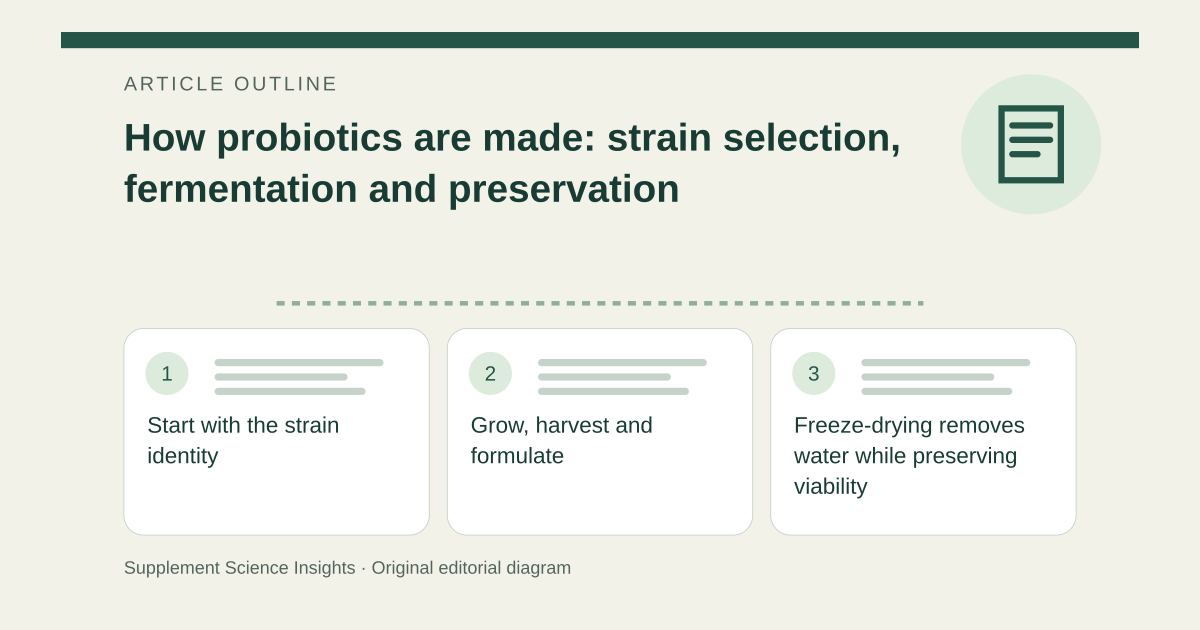
Start with the strain identity
Novonesis describes selecting and documenting strains before developing growth conditions for fermentation. Strain identity matters because a clinical result is not transferable to every organism with a similar name. This manufacturer description explains its process; it is not independent verification of every finished retail product. [1][2]
Grow, harvest and formulate
The manufacturer describes cultivation through fermentation, harvesting for further processing, and selecting the blend, dosage form and packaging. Products may become powders, capsules or other formats. Additional ingredients and handling can change the final preparation, so the starting culture is not the complete product description. [1]
Freeze-drying removes water while preserving viability
ISAPP explains that cells are frozen and water is removed under low pressure by sublimation. The resulting low-water environment can keep surviving microbes dormant. Dry appearance therefore does not mean all the organisms are dead, and dormancy is different from active growth. [3]
Stability must last beyond the factory
Some organisms can die during storage. Temperature, moisture, packaging and the preparation affect viability, so use the actual storage directions. NIH recommends attention to the viable amount through shelf life rather than relying only on a large count at manufacture. [3][2]
Separate manufacturing quality from treatment evidence
Imagine a product has a documented strain and a viable-count guarantee. Those are useful quality details, but a claim about treating a symptom still needs relevant evidence for that strain and preparation. Fermentation expertise cannot substitute for the clinical outcome comparison. [2]
| Stage | Question |
|---|---|
| Strain selection | Is the organism precisely identified? |
| Growth and processing | Is the preparation controlled? |
| Storage | Does the stated viable amount remain? |
| Clinical use | Does evidence match the outcome? |
Sources for this article
- Novonesis | Our Strain to Solution™ service
Source consulted: 2026-09-21. This is a reference resource, not a claim that we conducted the studies or tested a product. - Probiotics - Health Professional Fact Sheet
Source consulted: 2026-09-21. This is a reference resource, not a claim that we conducted the studies or tested a product. - How do probiotics stay alive until they are consumed? - International Scientific Association for Probiotics and Prebiotics (ISAPP)
Source consulted: 2026-09-21. This is a reference resource, not a claim that we conducted the studies or tested a product.