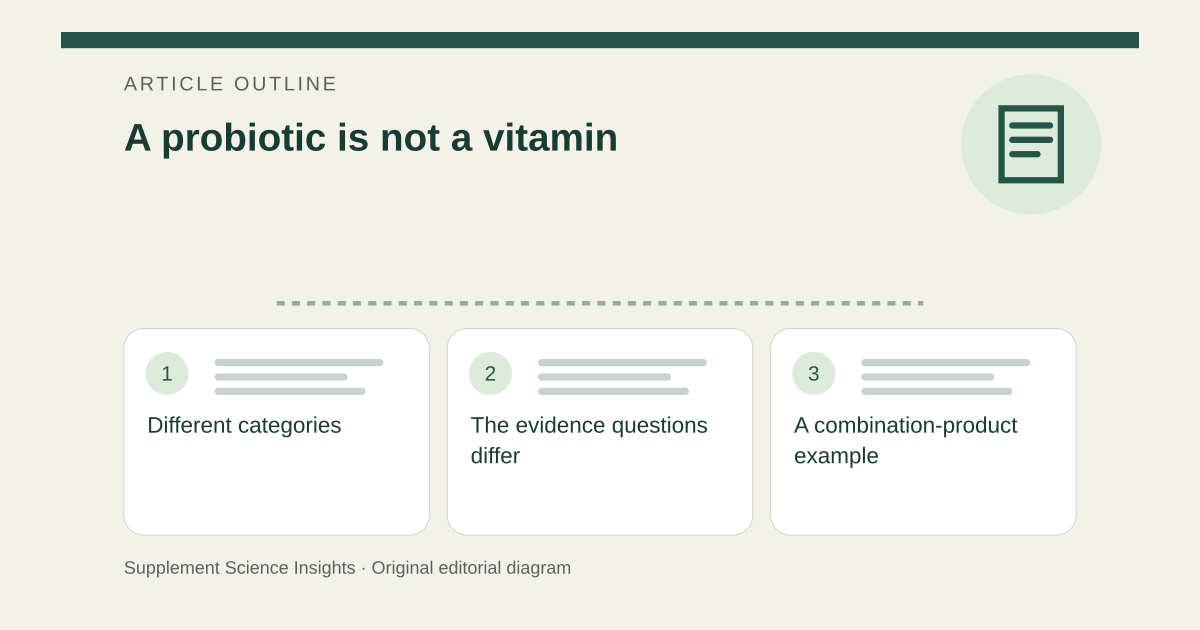
Different categories
The recognized essential vitamins are chemical nutrients needed for normal body function. Probiotics are live microorganisms that confer a health benefit when administered in adequate amounts. A capsule’s format does not decide which category it belongs to: capsules can contain vitamins, probiotic organisms or both. [1][2]
The evidence questions differ
For a vitamin, identify the nutrient and amount and whether intake is adequate. For a probiotic, identify the organism, strain, viable amount and evidence for the intended use. A large microorganism count alone does not establish a larger benefit. Vitamin Daily Values should not be applied to colony-forming units as though these were interchangeable measurements. [2][1]
A combination-product example
Imagine a supplement lists vitamin D in micrograms and a named bacterial strain in CFU. It contains a vitamin ingredient and a microorganism ingredient. Each needs its own interpretation; evidence for the vitamin does not prove the strain works, and a probiotic study does not establish that the added vitamin is needed. [2][1]
| Hypothetical ingredient | Category | Useful identifying information |
|---|---|---|
| Vitamin D | Vitamin | Form and micrograms |
| Named bacterial strain | Potential probiotic ingredient | Strain, viable amount and indication-specific evidence |
| Both in one capsule | Combination | Assess the components separately |
Sources for this article
- Vitamins: MedlinePlus Medical Encyclopedia
Source consulted: 2026-09-20. This is a reference resource, not a claim that we conducted the studies or tested a product. - Probiotics - Health Professional Fact Sheet
Source consulted: 2026-09-20. This is a reference resource, not a claim that we conducted the studies or tested a product.