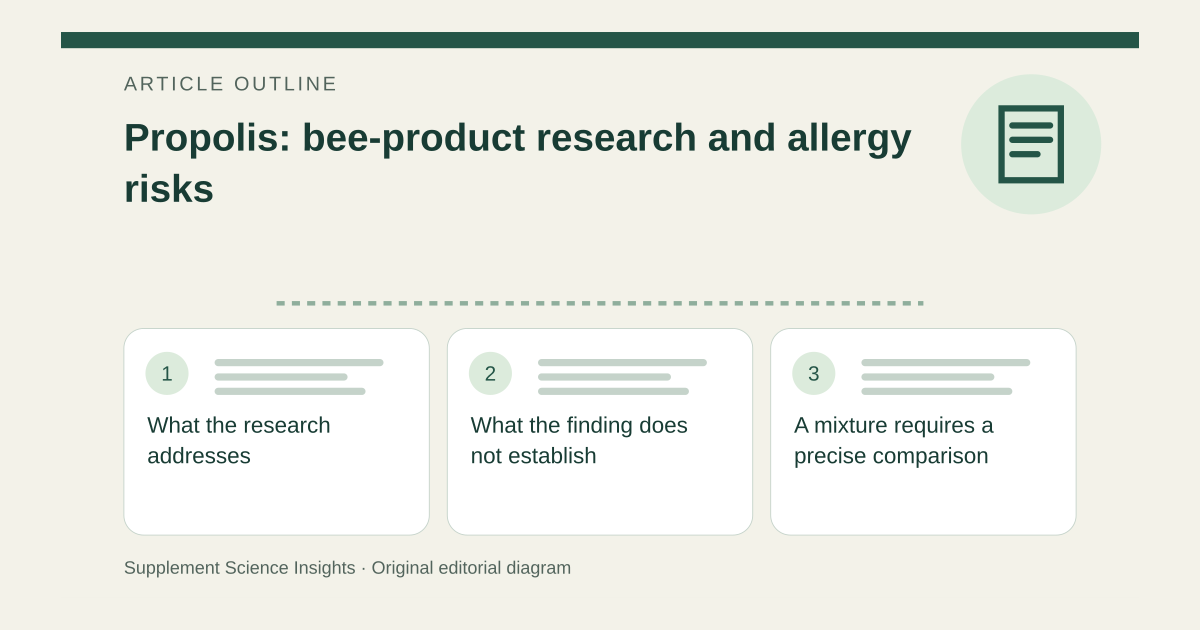
What the research addresses
Propolis is a resinous mixture collected by bees and used in oral and topical products. MSK describes limited, mixed clinical evidence. Some findings involve combination products, making it difficult to isolate a contribution from propolis. [1]
What the finding does not establish
Studies of local dental applications do not establish the effects of swallowed capsules. Findings for bee pollen or other bee products should not automatically be assigned to propolis, or vice versa. [1]
A mixture requires a precise comparison
Imagine one trial studies cranberry plus propolis and another tests propolis alone. A favorable result for the combination cannot reveal whether cranberry, propolis, their interaction or another study difference explains it. Preserve the complete formula when summarizing the finding.
The same care applies to how a product is used. A spray applied to the mouth and a capsule swallowed daily create different exposures. A useful product claim would identify the relevant preparation, intended outcome and comparison instead of treating every bee-related citation as interchangeable support.
| Hypothetical finding or choice | What it means |
|---|---|
| Cranberry plus propolis studied | A result about the combination |
| A locally applied preparation | Not proof for a swallowed capsule |
| A bee-product allergy history | Relevant even to a natural-product label |
Safety and treatment considerations
Propolis can cause contact allergy and systemic reactions. MSK advises avoidance with relevant bee-product or pollen allergies and records a possible warfarin interaction involving bee pollen. Serious adverse-event reports exist, but cannot establish their frequency or a safe exposure. [1]
A practical next step
This guide does not recommend a propolis product. Describe any prior reactions and show the full ingredient list when discussing use, particularly alongside medicines or treatment.
Sources for this article
- Memorial Sloan Kettering Cancer Center — Propolis
Source consulted: 2026-09-17. This is a reference resource, not a claim that we conducted the studies or tested a product.