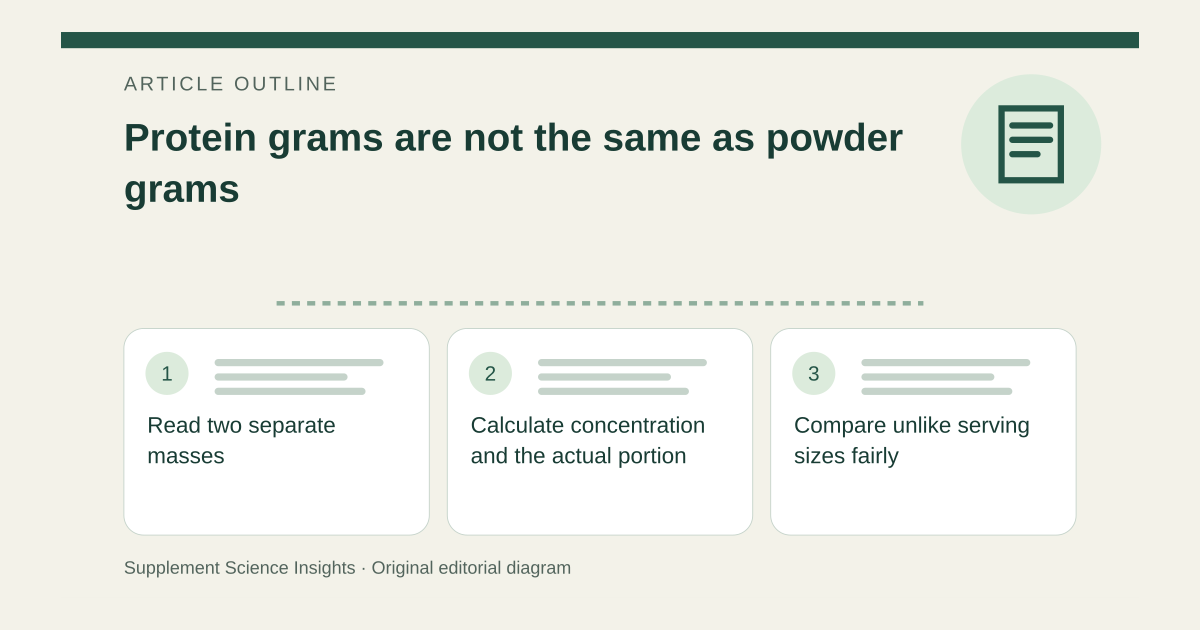
Read two separate masses
A label might describe a 30 g powder serving that supplies 24 g protein. The remainder can include other declared nutrients, moisture and ingredients; a serving’s full weight is not all protein. FDA’s label guidance emphasizes reading the serving size before interpreting nutrient quantities. [1]
Calculate concentration and the actual portion
For that hypothetical label, protein is 24 divided by30, or80% of powder weight. A 15 g half-serving supplies12 g protein if the mixture is uniform. A scoop is a volume measure and may be overfilled, so a gram weight is the clearer input for a food log. Neither the calculation nor a printed declaration is an independent laboratory assay. [1]
Compare unlike serving sizes fairly
Imagine powder A supplies24 g protein in30 g powder and powder B supplies25 g in40 g. B has one more gram per listed serving, but A has more protein per gram of powder:80% versus62.5%. This comparison does not evaluate amino-acid quality, allergens or whether either product is needed. [1][2]
| Hypothetical product | Powder serving | Protein | Protein fraction |
|---|---|---|---|
| A | 30 g | 24 g | 80% |
| B | 40 g | 25 g | 62.5% |
Sources for this article
- How to Understand and Use the Nutrition Facts Label | FDA
Source consulted: 2026-09-20. This is a reference resource, not a claim that we conducted the studies or tested a product. - Dietary Supplements for Exercise and Athletic Performance - Health Professional Fact Sheet
Source consulted: 2026-09-20. This is a reference resource, not a claim that we conducted the studies or tested a product.