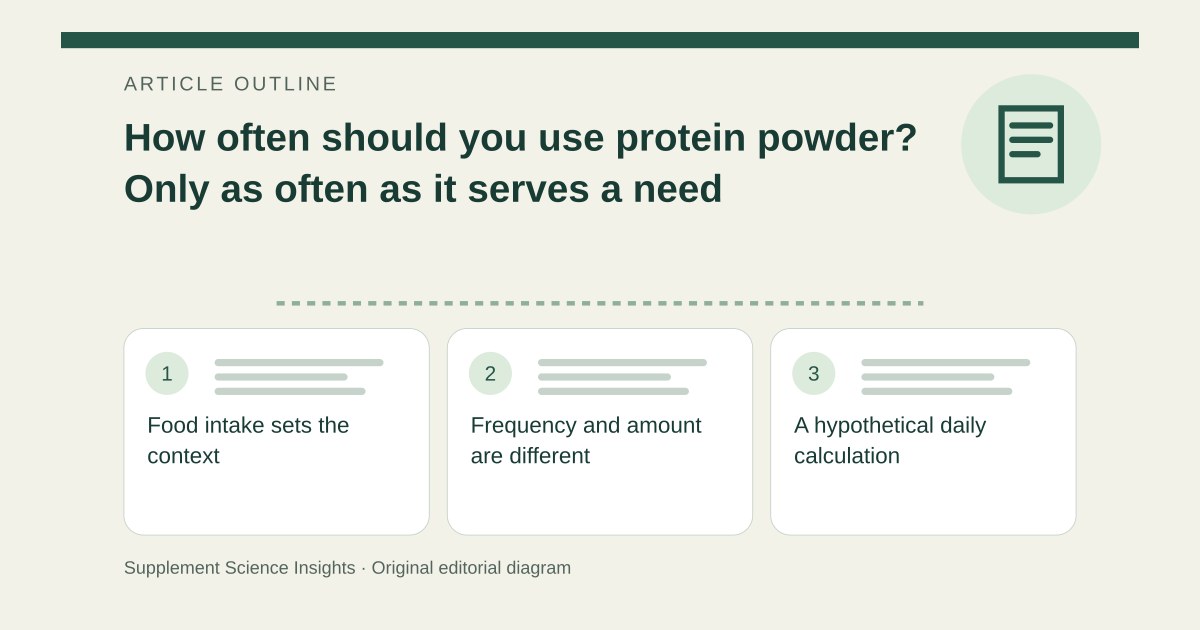
Food intake sets the context
Dietary protein supplies amino acids needed for tissue maintenance and training adaptation. Many ordinary foods provide it. A powder can be useful when meals leave a gap, but taking it daily is not inherently better than obtaining enough protein from food. A training day and a rest day both belong to the broader nutrition plan. [1]
Frequency and amount are different
Two small shakes can provide the same protein as one larger shake. Count the declared protein in each serving, not just how often a bottle is used. Replacing varied meals with repeated shakes also changes more than protein intake, so consider the rest of the diet rather than maximizing the number of servings. [1]
A hypothetical daily calculation
Suppose a person’s individualized plan calls for 100 g protein, and food supplies 80 g. A 20 g addition could close that arithmetic gap, either once or divided into two 10 g portions. If food already supplies the planned amount, this example provides no reason for an extra shake. The 100 g figure is chosen for illustration, not a recommendation for every reader. [1]
| Hypothetical food intake against a 100 g plan | Arithmetic gap |
|---|---|
| 80 g | 20 g |
| 100 g | 0 g |
| Two powder portions of 10 g protein | 20 g combined |
Sources for this article
- Dietary Supplements for Exercise and Athletic Performance - Health Professional Fact Sheet
Source consulted: 2026-09-20. This is a reference resource, not a claim that we conducted the studies or tested a product.