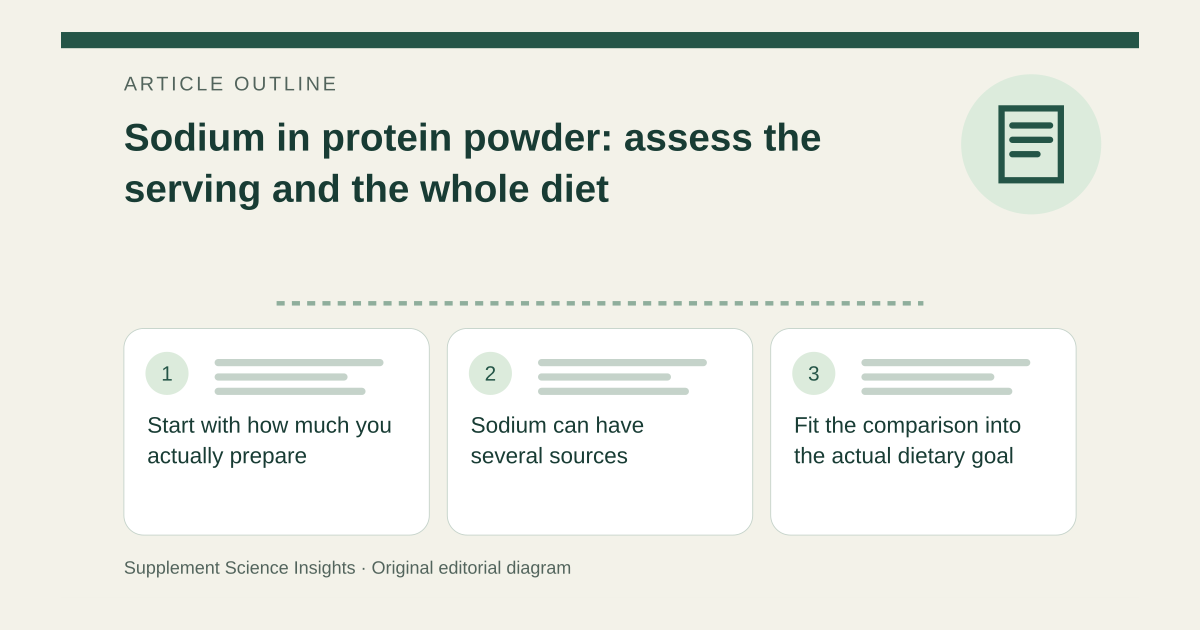
Start with how much you actually prepare
FDA’s general Daily Value for sodium is less than 2,300 mg daily. A serving with 5% DV or less is considered low, while 20% DV or more is high. These are general label-reading references, not an individualized medical target. [1]
Check how many servings go into the drink. Milk, other mixers and foods eaten alongside it contribute to the total. A number for dry powder alone is not the sodium content of the completed meal. [1]
Sodium can have several sources
Sodium is present in salt and in other food ingredients used for functions such as flavor, texture and preservation. A product can contain sodium without tasting strongly salty. The exact contribution cannot be inferred from the word protein or from sweetness. [1]
Similarly, reduced sodium is a comparison with a reference product, not a guarantee of a low absolute amount. FDA describes the claim as at least 25% less than the regular product. Compare the actual amounts and serving sizes. [1]
Fit the comparison into the actual dietary goal
High overall sodium intake can contribute to elevated blood pressure. A powder can be compared with alternatives as one part of the diet, while preserving its protein amount and other relevant characteristics. The lowest sodium number alone does not rank overall suitability. [1]
If a clinician has set a specific sodium target, use that plan. This page does not evaluate an actual brand or establish that all protein powders have similar sodium content. [1]
Multiple servings change the total
Imagine a powder contains 180 mg sodium per serving and a shake uses two servings. The powder contributes 360 mg before the mixer is counted. This arithmetic describes the fictional preparation, not a recommended serving size.
| Detail | Interpretation |
|---|---|
| 180 mg × two servings | 360 mg from powder |
| Mixer and other foods | Additional contributions |
| Reduced sodium | Relative claim, not necessarily low |
Sources for this article
- FDA: Sodium in Your Diet
Source consulted: 2026-09-17. This is a reference resource, not a claim that we conducted the studies or tested a product.