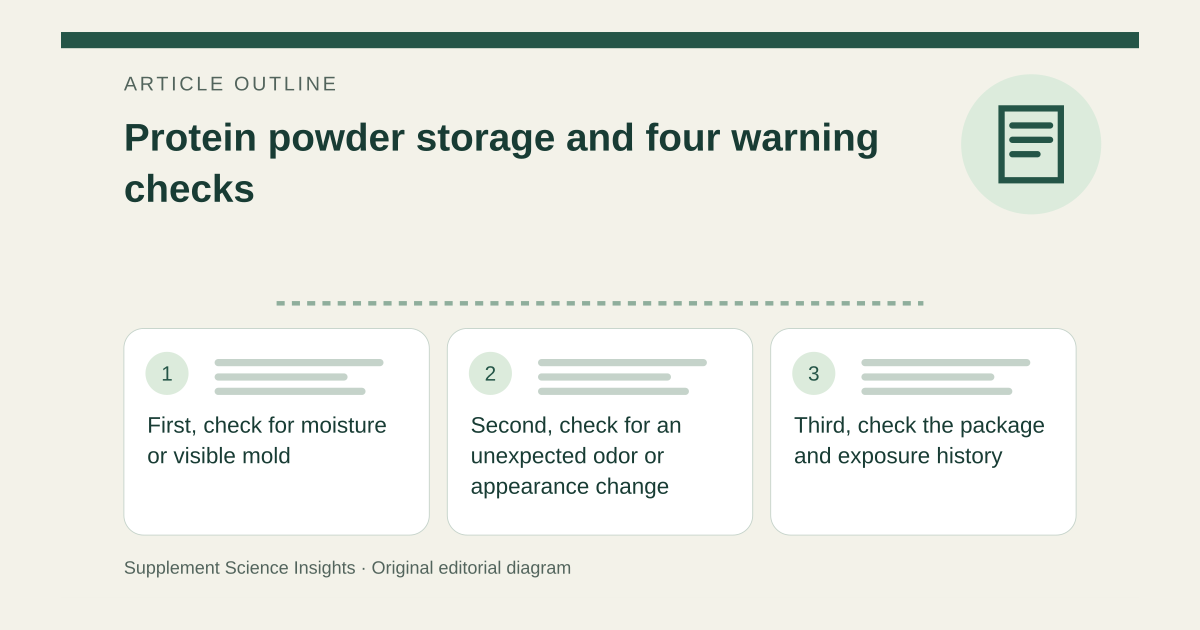
First, check for moisture or visible mold
Dry-food storage guidance emphasizes preventing moisture entry. Visible mold or a wet, deteriorated powder is a reason not to use it. A dry clump alone is not the same observation as mold; compare with the product’s normal condition and contact the manufacturer when uncertain. [1]
Second, check for an unexpected odor or appearance change
An abnormal change from the product’s usual smell or appearance is a reason to stop and investigate, not to mask it in a flavored shake. Do not taste a suspect powder as a safety test. Conversely, normal appearance is not a laboratory result. [1][2]
Third, check the package and exposure history
Look for damaged packaging, evidence of pests or an uncertain storage history. Keep the original product and lot information. A powder left open to moisture or contamination should not be treated as equivalent to an intact, correctly stored container merely because its date is the same. [1][3]
Fourth, check the date and manufacturer instructions
The inspected Optimum Nutrition storage instructions specify tight closure, a cool dry place and checking the package for batch and best-before information. Those are instructions for that product, not a universal number of months for every protein powder. Ask the maker about an unclear date or condition. [3]
Plan storage around how much you will use
Use clean, dry utensils and close the container promptly. Follow the actual package rather than inventing an indefinite shelf life through freezing, repacking or home treatment. Imagine buying a larger tub than can be used within its guidance: a smaller purchase is more practical than assuming storage can preserve it forever. [1][3]
| Check | Reason to investigate |
|---|---|
| Moisture or mold | Dry-storage condition compromised |
| Unexpected odor or appearance | Change from normal product |
| Package or exposure history | Possible contamination |
| Date and directions | Product-specific storage limits |
Sources for this article
- Food Storage Conditions — Utah State University Extension
Source consulted: 2026-09-21. This is a reference resource, not a claim that we conducted the studies or tested a product. - Dietary Supplements: What You Need to Know
Source consulted: 2026-09-21. This is a reference resource, not a claim that we conducted the studies or tested a product. - Optimum Nutrition Gold Standard 100% Whey Protein Powder EU storage instructions
Source consulted: 2026-09-21. This is a reference resource, not a claim that we conducted the studies or tested a product.