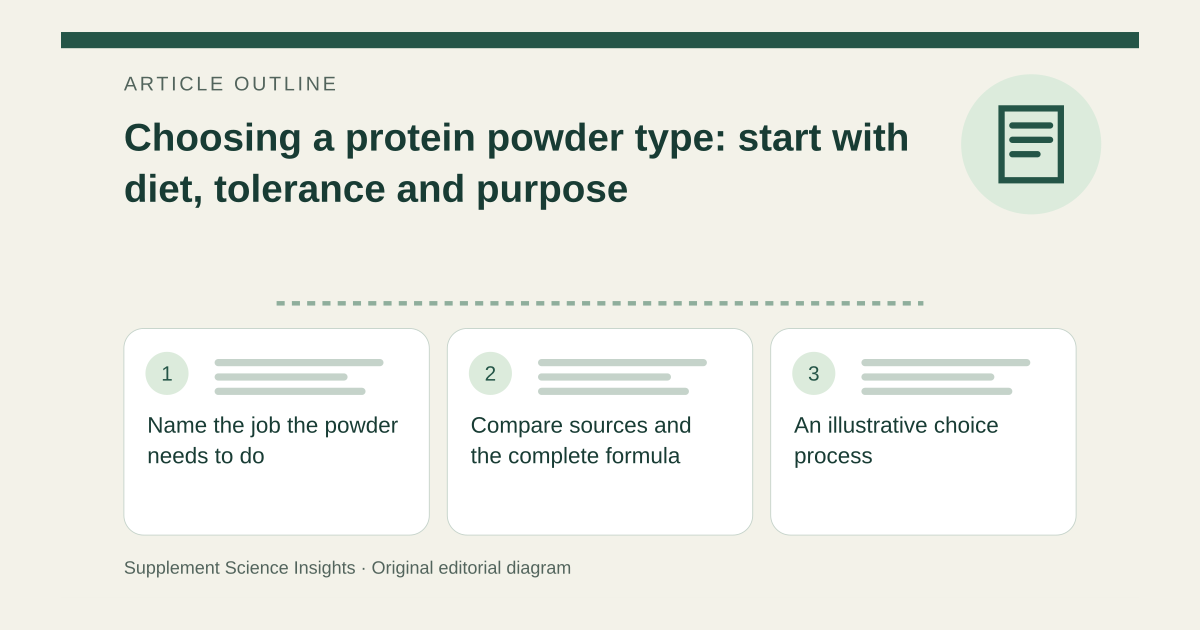
Name the job the powder needs to do
A convenient protein addition, a dairy-free ingredient and a more substantial snack are different goals. Adequate protein quality and quantity matter for training; the front-label word best does not define either. If food already meets the need, a supplement may be unnecessary. [1]
Compare sources and the complete formula
Whey and casein are milk proteins, so they do not suit someone avoiding dairy. Plant-source options require review of the source and any blend ingredients. Compare declared protein per serving, not powder weight alone. Flavor, tolerance and ease of mixing affect whether a product is useful in practice, but do not independently prove a clinical advantage. [2][1]
An illustrative choice process
Imagine someone wants a dairy-free 20 g protein addition. First exclude milk-derived protein sources, then inspect the remaining full formulas and servings that provide the intended amount. Another person who uses dairy and wants a simple shake may make a different choice. Neither choice establishes a universal winner, and exact needs can differ with health conditions and training. [1]
| Hypothetical priority | First comparison |
|---|---|
| Avoid dairy | Ingredient source and complete formula |
| Fill a specified protein gap | Declared protein per serving |
| Convenient everyday use | Preparation, tolerance and cost |
Sources for this article
- Dietary Supplements for Exercise and Athletic Performance - Health Professional Fact Sheet
Source consulted: 2026-09-20. This is a reference resource, not a claim that we conducted the studies or tested a product. - Whey vs. Casein Protein: Difference Explained | U.S. Dairy
Source consulted: 2026-09-20. This is a reference resource, not a claim that we conducted the studies or tested a product.