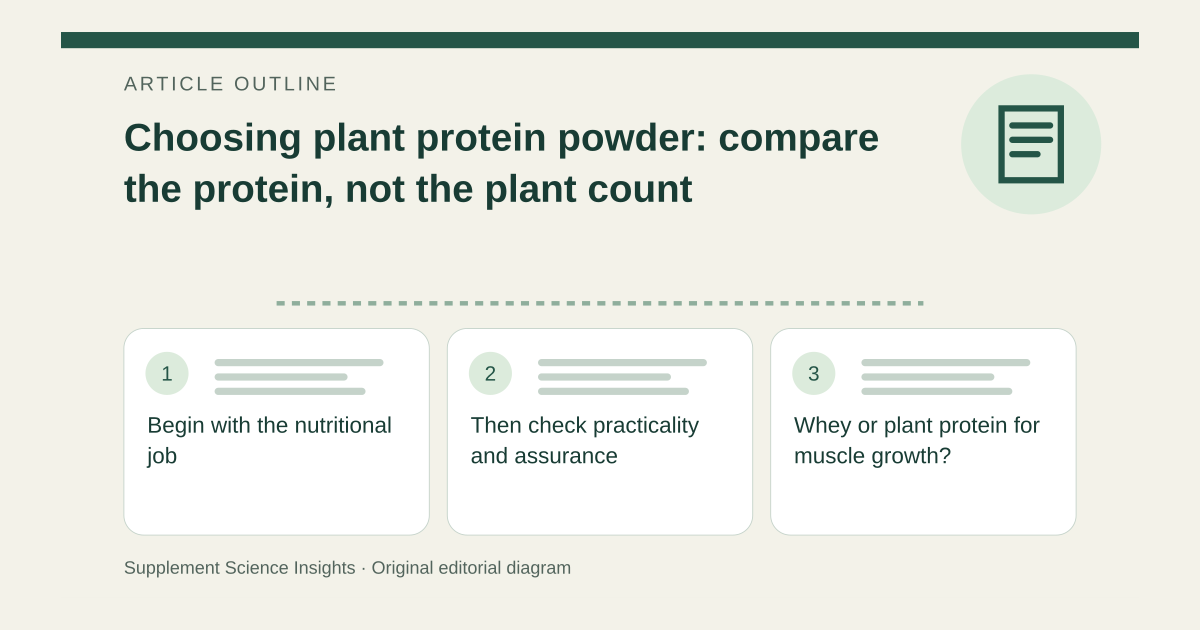
Begin with the nutritional job
Work out what the powder is intended to add to the diet. ODS describes both protein quantity and essential-amino-acid quality as relevant to athletes. A mixture with several plant names should not be assumed to supply more usable protein than a simpler ingredient at the actual serving taken. [1]
Then check practicality and assurance
Compare grams of protein per serving and per gram of powder, tolerance of the full formula and relevant allergy information. For sport, verify any claimed certification against the exact product. These checks improve the comparison without inventing a universal winner or assuming all plant powders share one contaminant profile. [1][2]
Whey or plant protein for muscle growth?
Whey is a convenient milk-derived protein that supplies essential amino acids. Plant powders can also contribute to a muscle-building diet, but the source, blend and amount matter. Compare protein per serving and amino-acid suitability within the whole diet, not equal scoop weights or the word plant alone. [3]
Choose a plant preparation when avoiding milk or following a vegan diet; choose whey when dairy fits your needs and you prefer that format. Neither category guarantees more muscle regardless of total intake and resistance training. The available sports guidance does not justify treating every plant powder as equivalent to whey, or every whey brand as superior to a suitable plant-based diet. [3]
A hypothetical value calculation
Suppose a tub costs30 currency units and contains20 servings of20 g protein. That is400 g declared protein, costing0.075 units per gram. Compare that with another tub using the same denominator, while keeping source suitability and testing separate. A cheaper gram is not automatically a safer or more useful one. [2][1]
| Hypothetical tub | Calculation |
|---|---|
| 20 servings ×20 g protein | 400 g declared protein |
| 30 currency units ÷400 g | 0.075 units per gram |
Sources for this article
- Dietary Supplements for Exercise and Athletic Performance - Health Professional Fact Sheet
Source consulted: 2026-09-20. This is a reference resource, not a claim that we conducted the studies or tested a product. - How to Understand and Use the Nutrition Facts Label | FDA
Source consulted: 2026-09-20. This is a reference resource, not a claim that we conducted the studies or tested a product. - NIH ODS: exercise and athletic performance, protein and creatine
Source consulted: 2026-09-25. This is a reference resource, not a claim that we conducted the studies or tested a product.