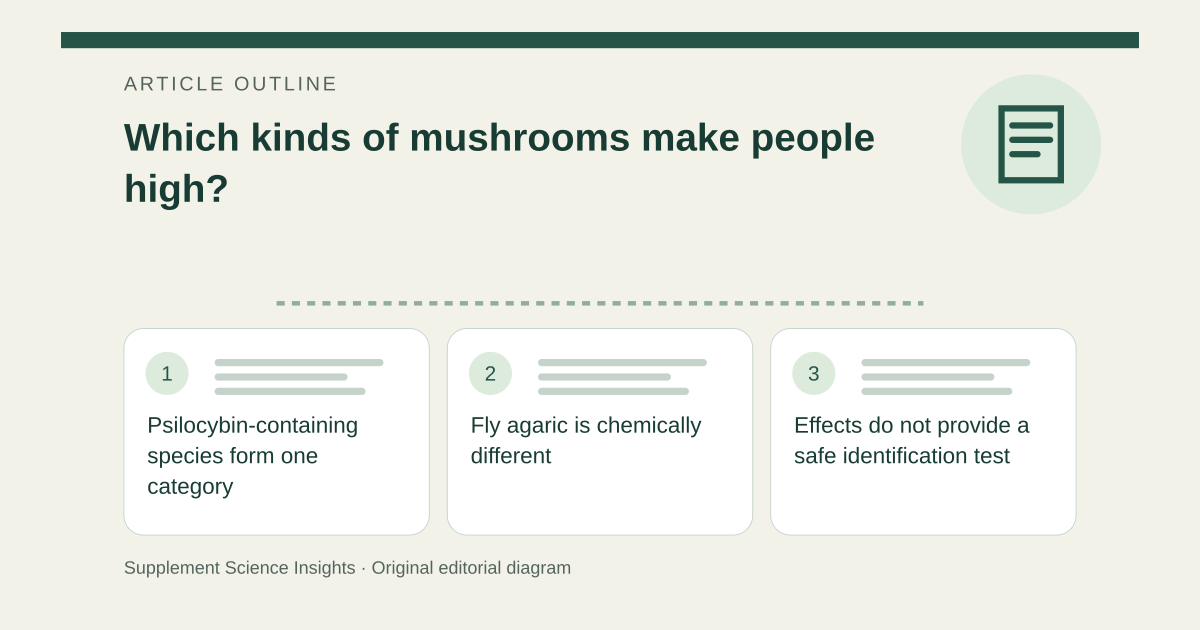
Psilocybin-containing species form one category
P. cubensis and the liberty-cap species P. semilanceata are familiar names in this area. EUDA describes psilocybin-containing fungi across more than one genus. A broad mushroom label therefore does not establish a single chemical profile. [1][2][3]
Fly agaric is chemically different
Amanita muscaria is associated chiefly with muscimol and ibotenic acid rather than the usual psilocybin mechanism. Its effects and toxicity should not be treated as equivalent to psilocybin research, and a legal-status claim does not establish safety. [3]
Effects do not provide a safe identification test
Psilocybin can change perception and mood but can also cause panic, confusion and cardiovascular effects. Poisonous species may resemble other mushrooms. Never taste an unknown specimen to determine which category it belongs to. [4][5]
Ask what a processed product actually contains
Imagine a mushroom gummy uses a fly-agaric picture while citing a psilocybin trial. The image, ingredients and study may refer to different substances. Without verified contents, neither the category nor the likely effects can be confidently inferred. [3][6]
| Category | Key distinction |
|---|---|
| Psilocybin-containing species | Serotonergic psychedelic compounds |
| Amanita muscaria | Different principal compounds |
| Culinary mushrooms | Food, not automatically psychedelic |
| Processed mushroom blend | Identity must be established |
Sources for this article
- Exploring Psilocybe cubensis Strains: Cultivation Techniques, Psychoactive Compounds, Genetics and Research Gaps - PMC
Source consulted: 2026-09-21. This is a reference resource, not a claim that we conducted the studies or tested a product. - Taxonomy browser Taxonomy Browser (Psilocybe semilanceata)
Source consulted: 2026-09-21. This is a reference resource, not a claim that we conducted the studies or tested a product. - Hallucinogenic mushrooms drug profile | EUDA
Source consulted: 2026-09-21. This is a reference resource, not a claim that we conducted the studies or tested a product. - Psilocybin for Mental Health and Addiction: What You Need To Know | NCCIH
Source consulted: 2026-09-21. This is a reference resource, not a claim that we conducted the studies or tested a product. - Magic Mushrooms (Psilocybin) Safety | California Poison Control System
Source consulted: 2026-09-21. This is a reference resource, not a claim that we conducted the studies or tested a product. - Psychedelic and Dissociative Drugs | National Institute on Drug Abuse (NIDA)
Source consulted: 2026-09-21. This is a reference resource, not a claim that we conducted the studies or tested a product.