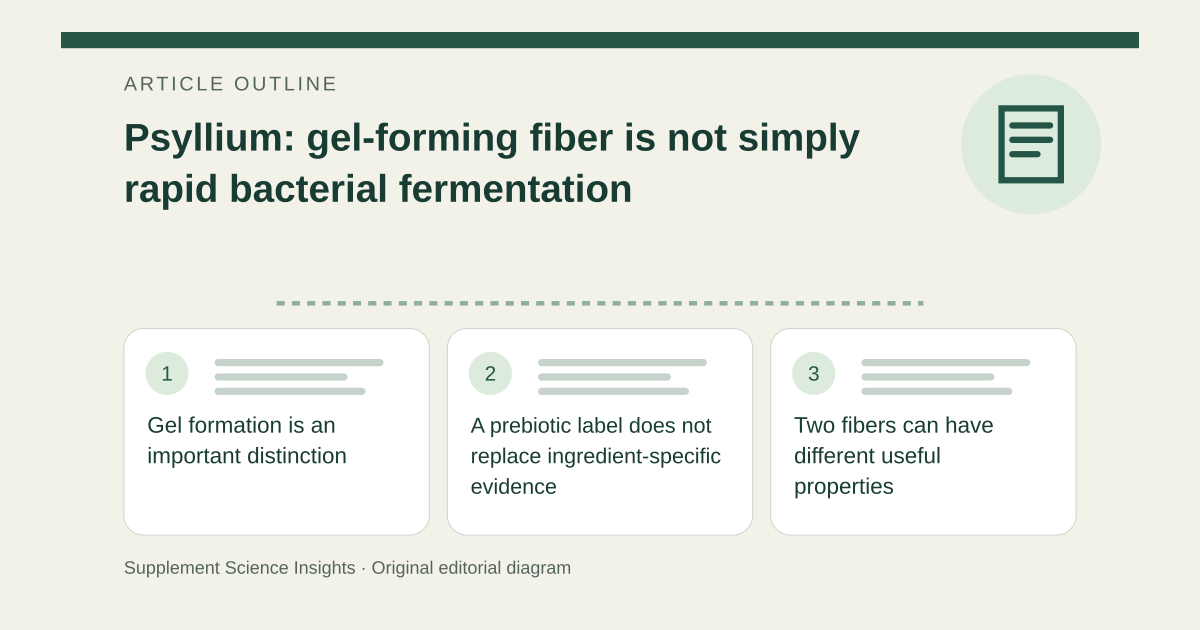
Gel formation is an important distinction
The ACG account links psyllium’s physical properties with changes in stool consistency and bulk. This differs from describing all fibers as rapidly fermented substrates that work in the same way. [1]
Fiber categories overlap, but the same general word does not establish identical fermentation or bowel effects. The particular fiber and outcome matter. [1]
A prebiotic label does not replace ingredient-specific evidence
Do not assume that psyllium should be selected or dosed by comparing it directly with inulin, FOS or another substrate. Evidence for one fiber does not establish the same effect for another. [1]
This page explains the mechanism distinction rather than defining a personal regimen. Tolerability and the reason for use still belong in an appropriate clinical or dietary discussion. [1]
Two fibers can have different useful properties
Imagine one product forms a water-holding gel while another is readily fermented. Equal grams do not prove that both produce the same stool response.
| Detail | Interpretation |
|---|---|
| Psyllium | Poorly fermented gel-forming fiber |
| Generic fiber claim | Too broad for equivalence |
| Desired bowel outcome | Match ingredient evidence |
Sources for this article
- ACG - IBS Treatment
Source consulted: 2026-09-18. This is a reference resource, not a claim that we conducted the studies or tested a product.