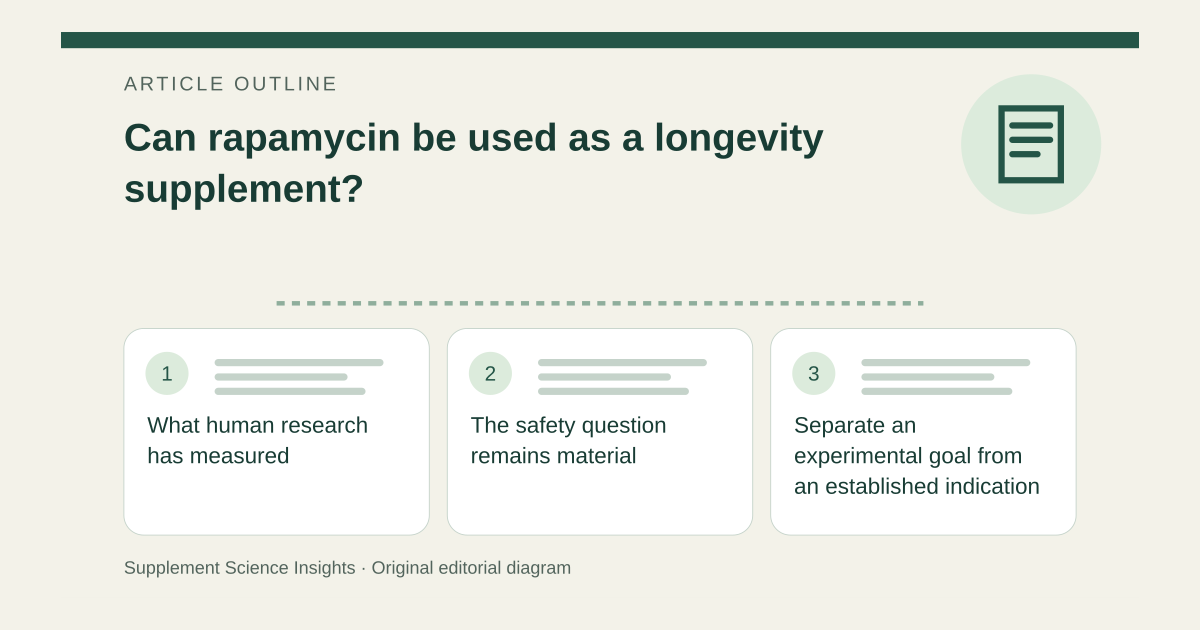
What human research has measured
A systematic review included 19 studies of rapamycin or related drugs. It reported improvements in some immune, cardiovascular and skin-related measures, with no significant effects in several other systems and some systems unexamined. Changes in these measures are not equivalent to a demonstrated extension of human life. [1]
The safety question remains material
The review reported more infections and lipid increases in participants with aging-related diseases and called for longer-term research. MedlinePlus warns that sirolimus suppresses infection defenses and can cause serious adverse effects. Results from selected study participants cannot supply a universal anti-aging regimen. [1][2]
Separate an experimental goal from an established indication
Imagine an advertisement presents an animal lifespan result as a personal forecast. That skips the human outcome and risk questions. A clinician would need to assess the indication, interacting medicines and monitoring requirements. Do not interpret a longevity claim as authorization to change prescribed treatment or self-prescribe sirolimus. [2][1]
| Claim | What it establishes |
|---|---|
| Mechanism or product name | A question to investigate |
| Matching human outcome | Evidence needed for a benefit claim |
| Individual suitability | Requires the actual formulation and context |
Sources for this article
- Targeting ageing with rapamycin and its derivatives in humans: a systematic review.
Source consulted: 2026-09-21. This is a reference resource, not a claim that we conducted the studies or tested a product. - Sirolimus: MedlinePlus Drug Information
Source consulted: 2026-09-21. This is a reference resource, not a claim that we conducted the studies or tested a product.