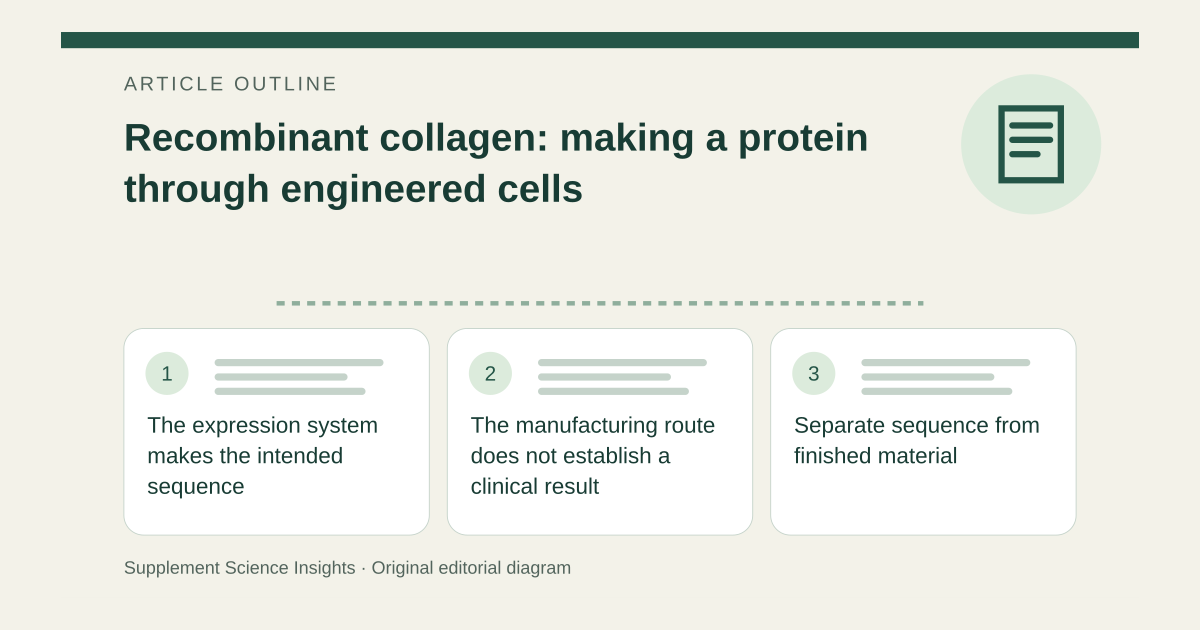
The expression system makes the intended sequence
A 2005 technology review describes engineered yeast and bacterial systems that produce recombinant human collagen or gelatin. Producing a sequence and reproducing every structural feature of native collagen are distinct technical challenges. [1]
The review discusses co-expression of prolyl hydroxylase to support hydroxylation and triple-helix formation. It also describes control over fragment length and composition. [1]
The manufacturing route does not establish a clinical result
The review describes two material applications: recombinant collagen able to assemble into fibrils for medical biomaterial development, and controlled-length collagen fragments intended to substitute for animal-derived gelatin. These are uses of the manufactured material, rather than evidence that swallowing a recombinant preparation improves skin or joints. The intended application still determines which structural, safety and performance tests are needed. [1]
This older review explains a production principle; it is not a current market survey or a comparison of finished consumer products. Recombinant does not by itself specify the final protein structure, purity or intended use. [1]
A biomedical material, a research reagent and an oral supplement require different evidence. Clinical superiority cannot be inferred from the production method alone. [1]
Separate sequence from finished material
Imagine two recombinant products with different fragment lengths. Sharing a production label does not make their structures or applications interchangeable.
| Detail | Interpretation |
|---|---|
| Expression system | Produces a designed sequence |
| Processing | Affects final structure |
| Clinical benefit | Requires separate evidence |
Sources for this article
- Recombinant microbial systems for the production of human collagen and gelatin - PubMed
Source consulted: 2026-09-17. This is a reference resource, not a claim that we conducted the studies or tested a product.