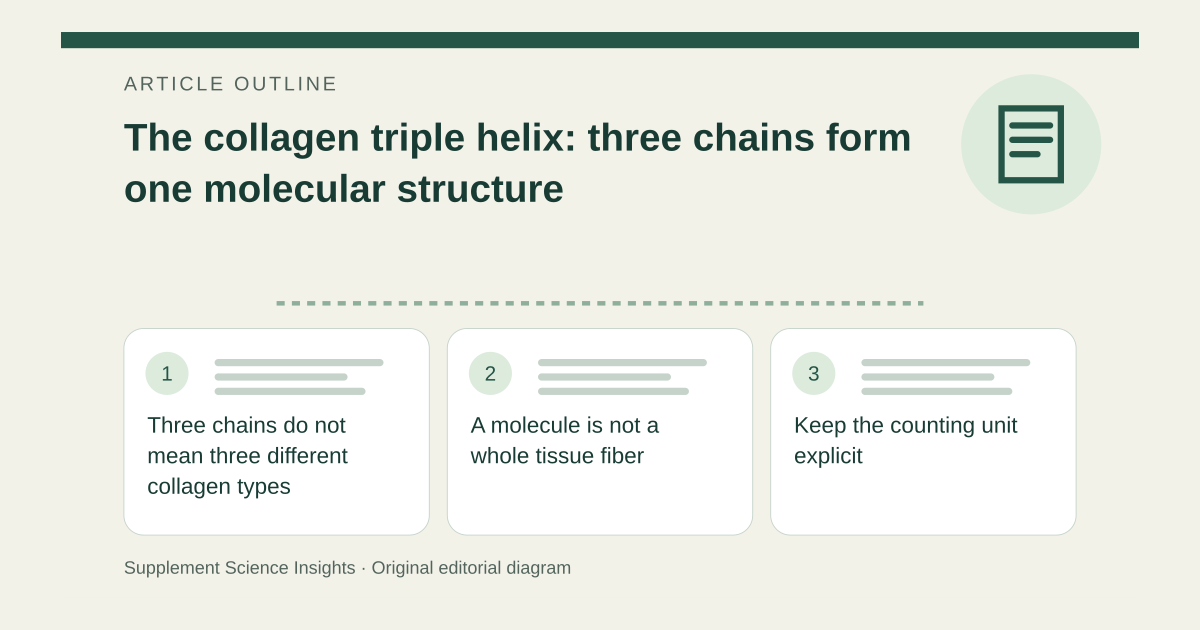
Three chains do not mean three different collagen types
The triple helix describes the arrangement of three polypeptide chains within a collagen molecule. In the usual type I molecule, two chains come from COL1A1 and one from COL1A2. These chains together make type I collagen; they are not types I, II and III combined. [1][2]
MedlinePlus describes precursor molecules being processed inside and outside cells before mature collagen assembles into larger structures. The word triple therefore concerns molecular architecture rather than a product containing three ingredients. [1][2]
A molecule is not a whole tissue fiber
Mature molecules can assemble into fibrils, which participate in larger fibers and tissue structures. Cross-links help stabilize those assemblies. A diagram of the triple helix shows an essential molecular feature, but does not show every level that determines a tendon’s behavior. [1][2]
Descriptions such as triple collagen on a supplement label need their own definition. They should not be assumed to mean an intact triple helix, three chain types or clinical superiority. Structural biology alone cannot rank an oral product. [1][2]
Keep the counting unit explicit
Imagine a diagram shows three chains in one molecule and a second image shows many molecules in a fibril. Counting three chains does not mean the fibril contains only three molecules. The unit being counted changes between the images.
| Level or observation | Meaning |
|---|---|
| Three polypeptide chains | One triple-helical molecule |
| Many molecules | A larger assembly |
| Three ingredients on a label | A different use of the number |
Sources for this article
- MedlinePlus Genetics: COL1A1
Source consulted: 2026-09-17. This is a reference resource, not a claim that we conducted the studies or tested a product. - StatPearls: Biochemistry, Collagen Synthesis
Source consulted: 2026-09-17. This is a reference resource, not a claim that we conducted the studies or tested a product.