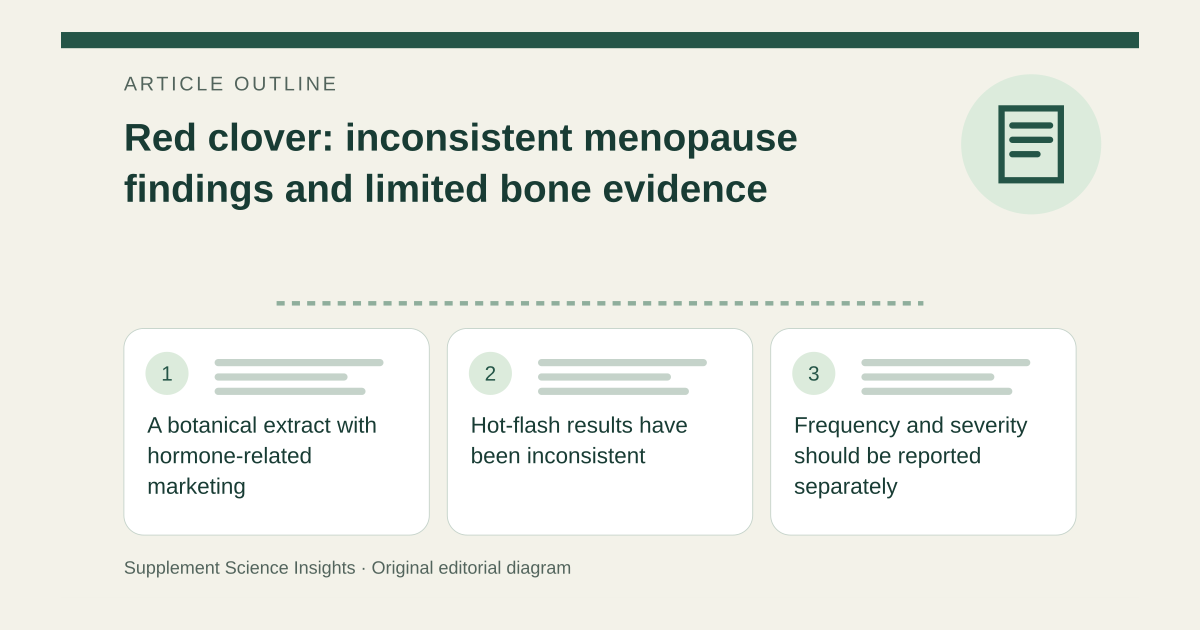
A botanical extract with hormone-related marketing
Red clover, Trifolium pratense, is commonly sold in extracts and promoted for menopausal symptoms. Products often emphasize isoflavones. A constituent description can help identify a preparation, but it cannot establish a clinical benefit by itself. [1]
Red clover, soy foods and isolated soy isoflavones are different interventions. Shared marketing language does not make their evidence interchangeable. Record the actual botanical and formulation before comparing a symptom claim. [1]
Hot-flash results have been inconsistent
NCCIH finds no conclusive evidence of benefit for a health condition. Studies of hot flashes have produced inconsistent results, and some have a high risk of bias. That uncertainty should remain visible even when a product highlights one positive trial. [1]
Possible cholesterol effects in postmenopausal women require further confirmation. Only a small number of studies have examined bone density, with inconsistent results. A bone-density measurement is not the same endpoint as fewer fractures, and the latter should not be implied without direct evidence. [1]
Frequency and severity should be reported separately
A hot-flash study may measure the number of episodes, their severity, sleep disruption or a combined symptom score. Those outcomes are related but not interchangeable. A combined score can improve even when one component remains unchanged.
Look for the initial symptom burden and what happened in the comparison group. Symptoms can vary over time, and expectations can affect subjective reporting. A before-and-after improvement alone cannot isolate an extract's contribution or show that another formulation will produce the same result.
Studied tolerability has a defined scope
Red-clover extracts have generally been tolerated in studies, including some lasting up to two years. This describes the preparations and participants studied; it does not establish safety for all products, combinations or clinical settings. [1]
NCCIH warns that supplements may be unsafe during pregnancy or breastfeeding. People receiving treatment should review the full supplement with their care team. A hormone-related marketing category should not be used to invent individualized safety assurances or to replace an assessment of persistent symptoms. [1]
Keep the comparator in a symptom calculation
Imagine a fictional study reports hot flashes decreasing from eight to five per day in the extract group and from eight to six in the placebo group. The difference in improvement is one episode per day, not three.
Whether that difference is reliable or meaningful requires the study's uncertainty, duration and other outcomes. The invented figures are an interpretation exercise, not an expected red-clover benefit.
| Hypothetical group | Daily episode change |
|---|---|
| Extract | 8 to 5: three fewer |
| Placebo | 8 to 6: two fewer |
| Difference in improvement | One episode per day |
Constituent identity is only the beginning
A useful claim needs a defined preparation and credible evidence for the particular symptom or outcome. This page does not recommend red clover for menopause or bone protection. It preserves inconsistent findings rather than converting an isoflavone label into a treatment verdict.
Sources for this article
- NCCIH — Red clover: Usefulness and Safety
Source consulted: 2026-09-17. This is a reference resource, not a claim that we conducted the studies or tested a product.