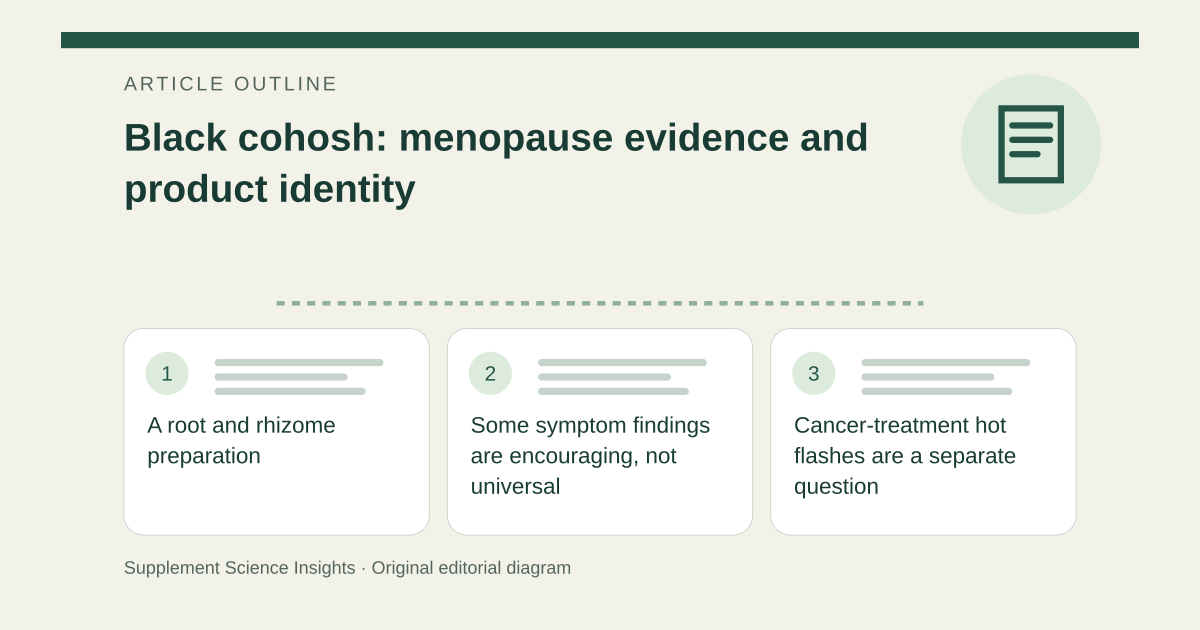
A root and rhizome preparation
Black cohosh is Actaea racemosa, also known as Cimicifuga racemosa. Its root or rhizome is used in herbal preparations. It is not blue cohosh, a different plant with its own risks. [1]
A comparison should begin with botanical identity and extract details. Similar common names are not evidence of equivalent ingredients. The exact preparation also matters when a study is used to support a menopause claim. [1]
Some symptom findings are encouraging, not universal
NCCIH describes a review suggesting possible improvement in overall menopause symptoms and hot flashes with certain black-cohosh-containing products. Findings did not establish the same benefit for anxiety or depressive symptoms, and some products contained additional herbs. [1]
Menopause is therefore too broad an endpoint by itself. Ask which symptom changed, how it was measured, whether the change mattered to participants and what comparison was used. A combined score can conceal different results for individual symptoms. [1]
Cancer-treatment hot flashes are a separate question
Whether black cohosh helps hot flashes associated with breast-cancer treatment is uncertain. Safety after hormone-sensitive conditions is also unresolved. A result in another population should not be imported into that setting without appropriate evidence. [1]
The useful next step is a discussion with the treating team about the particular symptom and complete treatment plan. A supplement should not become a reason to interrupt a prescribed therapy or delay assessment of new symptoms. [1]
Liver reports and misidentification both matter
Rare serious liver-injury reports have involved products labeled black cohosh, although causation is uncertain. Some commercial products have contained incorrect or undeclared herbs. Neither uncertainty should be presented as proof that all reported injuries are unrelated to the product. [1]
Seek medical advice for concerning symptoms such as dark urine or jaundice during use. Pregnancy and breastfeeding use may be unsafe. Product identity, medicine use and medical history should be assessed together. [1]
One symptom score cannot describe everything
Imagine a fictional study reports fewer hot flashes but no measurable change in mood symptoms. An accurate summary says the benefit was limited to the hot-flash outcome. “Improves all menopause symptoms” would overstate the result.
If the studied product also contained another herb, keep that fact in the summary. This example illustrates outcome reporting; it is not a description of a particular trial or a claim that an available bottle matches one.
| Hypothetical result | Accurate interpretation |
|---|---|
| Hot flashes improved | Symptom-specific finding |
| Mood outcome unchanged | Do not claim mood benefit |
| Combination formula | Do not isolate one herb |
Match the preparation and the clinical question
A useful menopause discussion names the symptom, its severity and the available options. An herbal product can then be evaluated in that context. This overview does not certify a retail extract, diagnose a hormonal imbalance or establish a treatment recommendation. A symptom diary can make the clinical discussion more specific without pretending to diagnose the cause of every change.
Sources for this article
- NCCIH — Black cohosh: Usefulness and Safety
Source consulted: 2026-09-17. This is a reference resource, not a claim that we conducted the studies or tested a product.