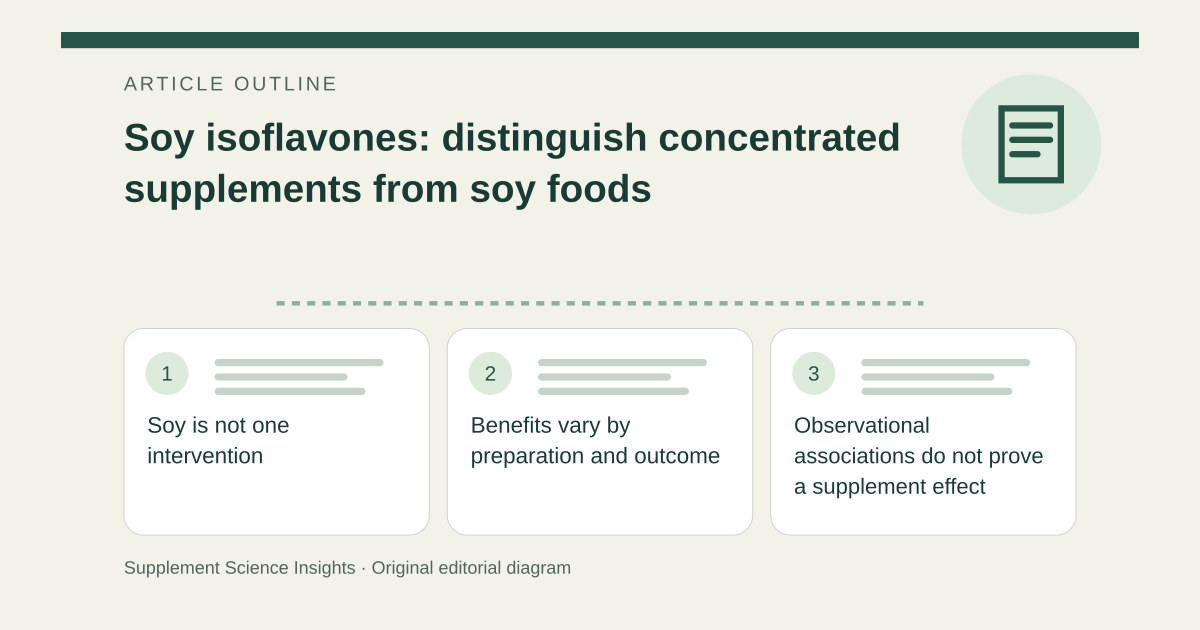
Soy is not one intervention
Soy foods provide a mixture of nutrients and constituents. Soy protein supplements and concentrated isoflavone extracts are different preparations. A study of replacing another protein with soy protein cannot automatically establish the effect of isolated isoflavones. [1]
For a claim, identify whether the intervention was a dietary pattern, a food, protein or an extract. Record the population as well. Findings from habitual dietary intake and findings from starting a supplement later in life have different designs and implications. [1]
Benefits vary by preparation and outcome
NCCIH notes that replacing other proteins with soy protein may slightly lower cholesterol; isoflavones may not have the same effect. Isoflavones or soy protein may modestly reduce menopausal hot flashes, although results are not fully consistent. [1]
Isoflavones probably benefit bone density in postmenopausal women and may modestly lower blood pressure. These findings should retain their endpoints: bone density is not a demonstrated fracture outcome, and a pressure change is not proof of fewer cardiovascular events. [1]
Observational associations do not prove a supplement effect
Higher dietary soy intake has been associated with lower breast-cancer risk in some Asian and Asian-American populations. Such studies describe dietary exposure and cannot establish that an isoflavone capsule prevents cancer. Supplements have not been shown to reduce that risk. [1]
Food patterns also differ in other ways that can affect outcomes. A careful summary distinguishes association from an intervention effect and does not assign every dietary finding to one isolated constituent. This is especially relevant when marketing borrows the credibility of ordinary foods. [1]
Allergy and concentrated exposure require attention
Soy allergy matters for both foods and supplements. Gastrointestinal symptoms can occur. Concentrated-extract safety findings cover defined study periods and should not be extended indefinitely or to every formulation. [1]
Certain high-tyramine soy products can interact with monoamine oxidase inhibitor medicines; the complete diet and product context matter. Supplemental amounts beyond ordinary food intake during pregnancy may be unsafe, and breastfeeding information at those exposures is limited. Discuss the actual preparation with the care team. [1]
Do not replace a dietary substitution with a capsule
Imagine a fictional trial replaces a portion of another protein with soy protein and observes a small cholesterol change. A capsule containing only isoflavones does not reproduce the protein substitution or the rest of the intervention.
The trial's result belongs to the studied dietary change. It does not establish that an isolated extract produces the same outcome at any particular amount.
| Hypothetical intervention | Why it matters |
|---|---|
| Protein replaced with soy protein | Dietary substitution |
| Isoflavone-only capsule | Different intervention |
| Same soy origin | Does not establish matching effect |
Match the product category before comparing results
Soy foods, soy protein and isoflavones deserve separate evidence descriptions. This reference does not recommend concentrated supplements for cancer prevention or hormone-related treatment. Keep modest findings, study populations and safety context attached to the exact preparation.
Sources for this article
- NCCIH — Soy isoflavones: Usefulness and Safety
Source consulted: 2026-09-17. This is a reference resource, not a claim that we conducted the studies or tested a product.