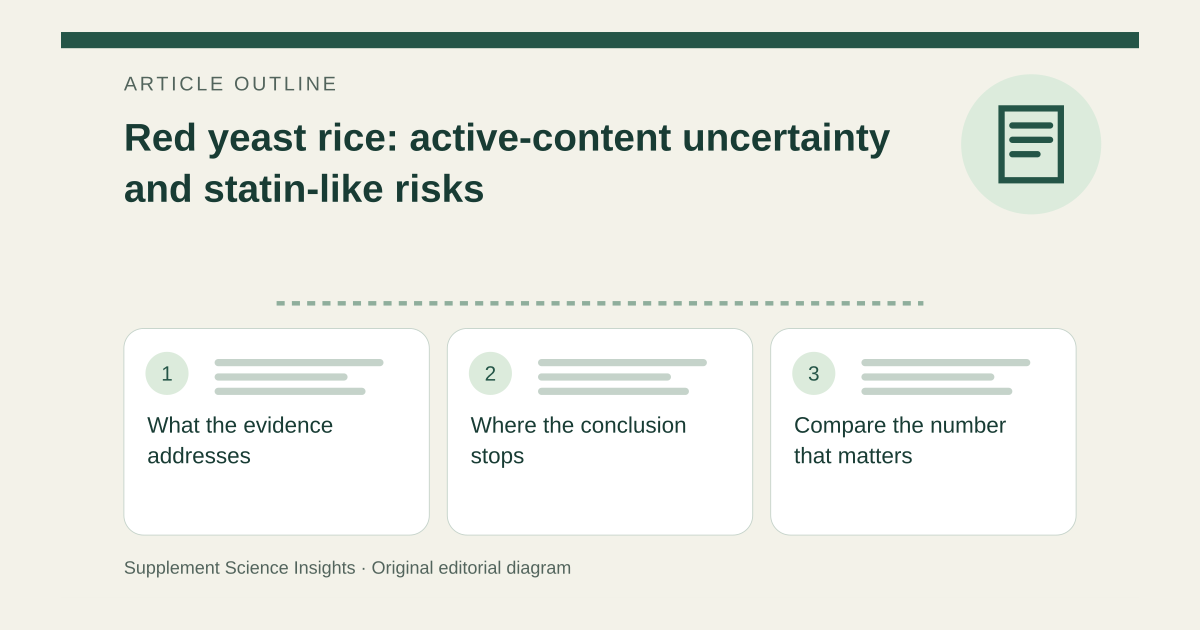
What the evidence addresses
Red yeast rice is made by fermenting rice with a fungus. NCCIH explains that some preparations contain monacolin K, which is chemically identical to lovastatin. Products vary substantially in this constituent, and labels generally do not tell consumers how much is present. [1]
Where the conclusion stops
Products with meaningful monacolin K content can lower cholesterol, while effectiveness is uncertain for products containing little of it. The milligrams of red yeast rice on a label do not establish the active amount. “Natural” does not mean free of drug-like effects. [1]
Compare the number that matters
Suppose two hypothetical labels each list 600 mg of red yeast rice per capsule. They match in declared material weight, but that does not tell you whether their active content matches. Doubling the capsule count doubles the stated rice weight; it does not resolve an unknown concentration or establish a safe dose.
A useful comparison needs to distinguish three questions: what the product contains, whether that exact preparation produces the desired outcome, and whether its risks fit the person considering it. A reassuring ingredient description cannot substitute for answers about active content and interactions.
| Hypothetical label detail | What can be concluded |
|---|---|
| 600 mg red yeast rice per capsule | The declared weight of the fermented material |
| Two capsules | 1,200 mg of that material, not a known monacolin dose |
| No monacolin K amount listed | The active exposure remains unresolved |
Safety and treatment considerations
Preparations containing substantial monacolin K can have statin-like interactions and muscle, liver or kidney harms. Citrinin contamination is an additional kidney concern. NCCIH advises against use during pregnancy or breastfeeding. Discuss cholesterol management and current medicines with a clinician rather than assuming this is a gentler replacement. [1]
A useful next step
This overview does not rank brands or recommend a dose. Bring the label to a cholesterol-care discussion and include other supplements and medicines in the same conversation.
Sources for this article
- NCCIH — Red Yeast Rice
Source consulted: 2026-09-17. This is a reference resource, not a claim that we conducted the studies or tested a product.