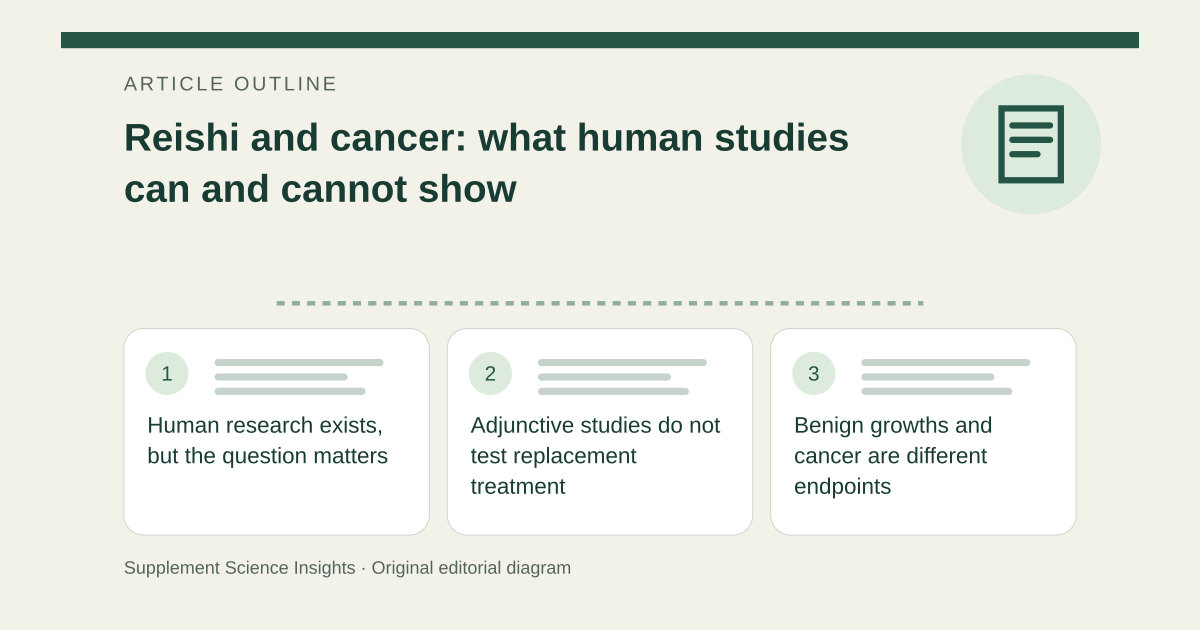
Human research exists, but the question matters
NCI describes studies of reishi products used alongside cancer care, including research on immune responses in people with lung cancer. Such findings can motivate further trials, but a changed immune-cell measurement is not the same as improved survival or proven tumor control. [1]
Adjunctive studies do not test replacement treatment
Some participants received chemotherapy, radiation or other treatments at the same time. An observation in that setting does not show what reishi would do by itself. MSK concludes that further research is needed to establish its safety and effectiveness as an adjunct in cancer care. [1][2]
Benign growths and cancer are different endpoints
NCI also summarizes research on benign colorectal tumors using a specific mycelial preparation. That is not proof that a retail reishi powder treats established colorectal cancer. Keep the population, preparation and outcome attached to the result rather than generalizing every tumor-related observation into a cure claim. [1]
Do not substitute evidence from another mushroom
NCI separately discusses turkey-tail-derived PSK and its use with cancer treatment in Japan. PSK findings do not automatically apply to reishi, a mushroom coffee or an uncharacterized turkey tail powder. The named preparation and treatment context are essential. [1]
Treatment and laboratory interactions need review
MSK cautions about bleeding risk, immune-related interactions and possible effects involving cancer treatments. Reishi spore products can also affect the tumor marker CA72-4. Tell the oncology team what you are taking before interpreting a changed result or starting a supplement. [2]
Ask for the patient-important outcome
Imagine an advertisement cites improved immune markers and promises cancer remission. Ask whether that exact product improved survival, symptoms or tumor outcomes in appropriate controlled human research. The inspected summaries do not justify abandoning standard treatment on that basis. [1][2]
| Finding | Limit |
|---|---|
| Immune marker change | Not proof of survival benefit |
| Adjunctive use | Not replacement treatment |
| Benign adenoma outcome | Not established cancer treatment |
| Different mushroom extract | Not interchangeable evidence |
Sources for this article
- Mushrooms - NCI
Source consulted: 2026-09-21. This is a reference resource, not a claim that we conducted the studies or tested a product. - Reishi Mushroom | Memorial Sloan Kettering Cancer Center
Source consulted: 2026-09-21. This is a reference resource, not a claim that we conducted the studies or tested a product.