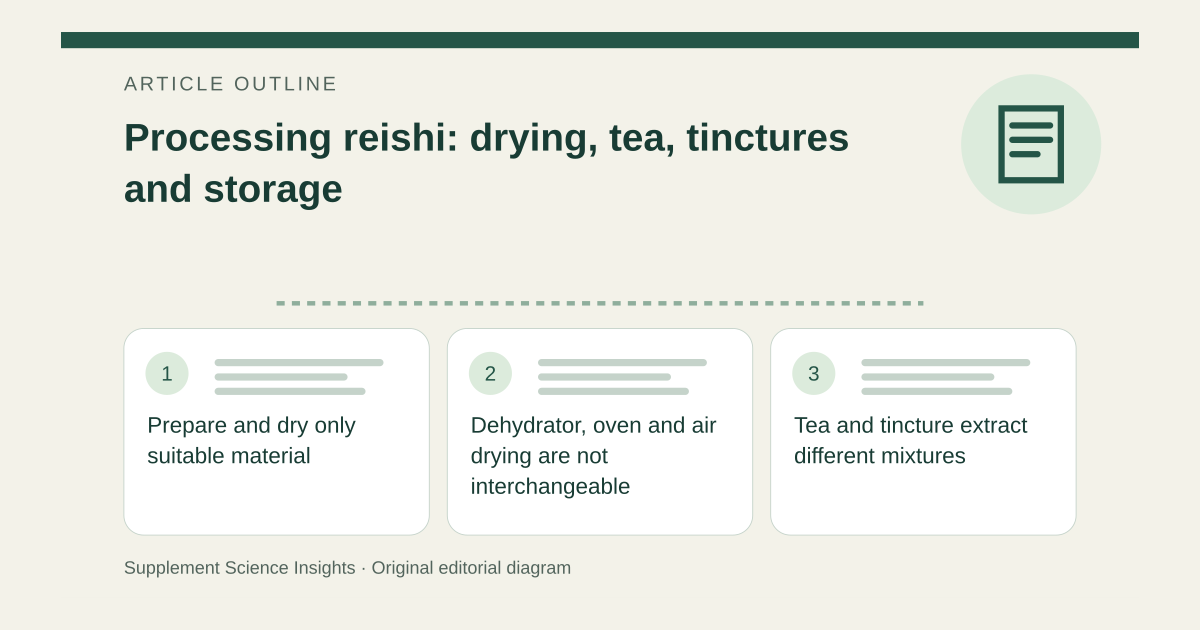
Prepare and dry only suitable material
OSU describes mature reishi as corky and tough. Work with a confirmed cultivated source, discard spoiled material and take care when cutting. General OSU edible-mushroom guidance uses thin pieces in a dehydrator around 120°F until crisp and brittle; that is preservation guidance, not a reishi-specific potency or sterilization protocol. [1][2]
Dehydrator, oven and air drying are not interchangeable
A temperature-controlled dehydrator provides more predictable airflow than leaving pieces in a room. An oven must support the low temperature and ventilation required by its drying instructions; a warm setting alone is not a verified method. Humid, still air can leave thick woody pieces damp. No universal drying time is established here. [2][1]
Tea and tincture extract different mixtures
A water preparation heats suitable material in water and separates the solids; a tincture uses an alcohol-containing solvent. Laboratory extraction often includes additional separation and purification. Follow a reputable finished product’s instructions rather than assuming a home brew matches a studied extract. Never use industrial or rubbing alcohol for an ingestible preparation. [3][4]
Store dry material separately from prepared liquids
Cool fully dried pieces before sealing them in a clean airtight container, and keep them dry and protected from heat and light. Do not assume a homemade tea or diluted tincture is shelf-stable. For example, a jar labeled with its species and preparation date still needs an appropriate storage method; labeling does not validate potency or safety. Reishi can cause adverse effects and interact with medicines. [2][4]
| Form | Key limitation |
|---|---|
| Dried pieces | Drying is not sterilization |
| Tea | Not a standardized extract |
| Tincture | Solvent and storage matter |
| Homemade blend | No established clinical dose |
Sources for this article
- Nontimber Forest Products for Small Woodland Owners: Reishi Mushroom Growing Guide | OSU Extension Service
Source consulted: 2026-09-21. This is a reference resource, not a claim that we conducted the studies or tested a product. - Preserving mushrooms | OSU Extension Service
Source consulted: 2026-09-21. This is a reference resource, not a claim that we conducted the studies or tested a product. - A Review of Development and Utilization for Edible Fungal Polysaccharides: Extraction, Chemical Characteristics, and Bioactivities - PMC
Source consulted: 2026-09-21. This is a reference resource, not a claim that we conducted the studies or tested a product. - Reishi Mushroom | Memorial Sloan Kettering Cancer Center
Source consulted: 2026-09-21. This is a reference resource, not a claim that we conducted the studies or tested a product.