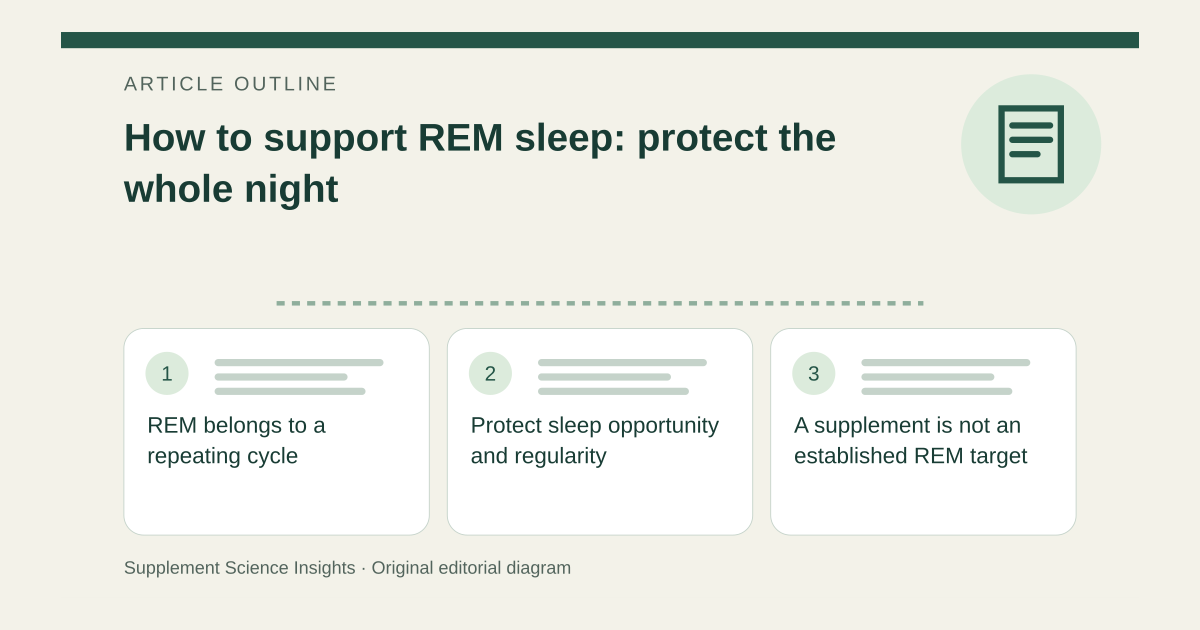
REM belongs to a repeating cycle
NHLBI describes REM and non-REM phases cycling through the night, usually over four to six cycles. REM becomes more prominent later in the night. Cutting the night short can therefore remove part of the opportunity for later REM periods; that is a timing consideration, not a way to calculate an individual REM deficit. [1]
Protect sleep opportunity and regularity
Keep a consistent bedtime and wake time and allow a quiet wind-down. NHLBI recommends a quiet, dark, cool bedroom, physical activity and time outdoors. Late caffeine and alcohol near bedtime can interfere with sleep. These habits support sleep broadly; they do not guarantee a particular stage percentage. [2]
A supplement is not an established REM target
Falling asleep faster is a different outcome from improving REM architecture or daytime functioning. NCCIH describes limited or inconsistent evidence for many sleep supplements and identifies CBT-I as the most strongly recommended treatment for insomnia. Persistent sleep problems deserve evaluation rather than repeated increases in melatonin or another product. [3]
Work backward from the required wake time
Imagine a fixed early wake time follows several nights of late bedtime. Start by restoring adequate sleep opportunity and a regular schedule. If sleep remains unrefreshing despite that opportunity, discuss the pattern with a clinician instead of assuming the missing ingredient is a REM supplement. [1][3]
| Pattern | Next question |
|---|---|
| Late bedtime and early alarm | Is there enough sleep opportunity? |
| Persistent difficulty despite opportunity | Is a sleep disorder present? |
Sources for this article
- How Sleep Works - Sleep Phases and Stages | NHLBI, NIH
Source consulted: 2026-09-20. This is a reference resource, not a claim that we conducted the studies or tested a product. - Sleep Deprivation and Deficiency - Healthy Sleep Habits | NHLBI, NIH
Source consulted: 2026-09-20. This is a reference resource, not a claim that we conducted the studies or tested a product. - Sleep Disorders and Complementary Health Approaches: Usefulness and Safety | NCCIH
Source consulted: 2026-09-20. This is a reference resource, not a claim that we conducted the studies or tested a product.