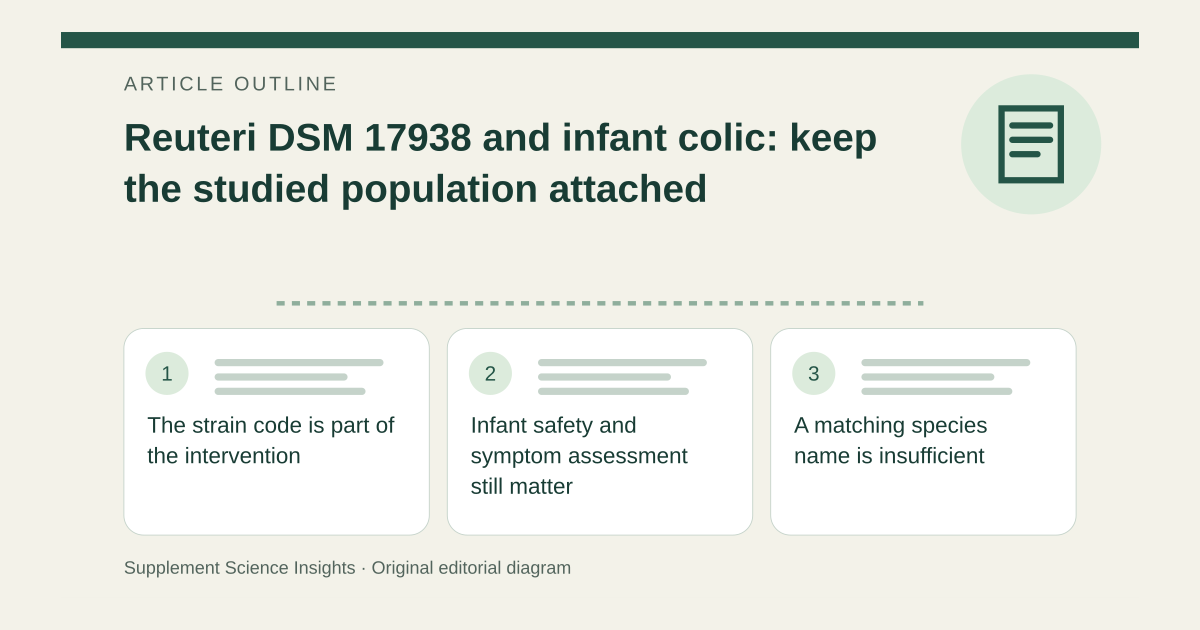
The strain code is part of the intervention
The Canadian trial randomized 52 breastfed infants with colic to DSM 17938 or placebo for 21 days. Parents recorded crying and fussing in structured diaries. [1]
The probiotic group had lower crying and fussing measures by the end of treatment. These findings concern a named strain in a specific short-term setting, not every product labeled reuteri. [1]
Infant safety and symptom assessment still matter
The small study does not establish benefit for all formula-fed infants or safety in premature or seriously ill infants. NCCIH notes particular concerns about probiotic use in vulnerable infants, so ordinary retail availability is not proof of suitability. [1][2]
Persistent crying also needs appropriate pediatric assessment rather than an assumption that it is uncomplicated colic. Funding and conflicts were not fully assessed from the trial abstract used here, and no individual dosing recommendation is inferred. [1][2]
A matching species name is insufficient
Imagine one bottle lists DSM 17938 and another lists a different reuteri strain. The shared species name does not make the second bottle the intervention tested in this trial.
| Detail | Interpretation |
|---|---|
| 52 infants | Breastfed colic population |
| 21 days | Short-term study |
| DSM 17938 | Specific strain |
Sources for this article
- Probiotics for infantile colic: a randomized, double-blind, placebo-controlled trial investigating Lactobacillus reuteri DSM 17938 - PubMed
Source consulted: 2026-09-19. This is a reference resource, not a claim that we conducted the studies or tested a product. - Probiotics: Usefulness and Safety | NCCIH
Source consulted: 2026-09-19. This is a reference resource, not a claim that we conducted the studies or tested a product.