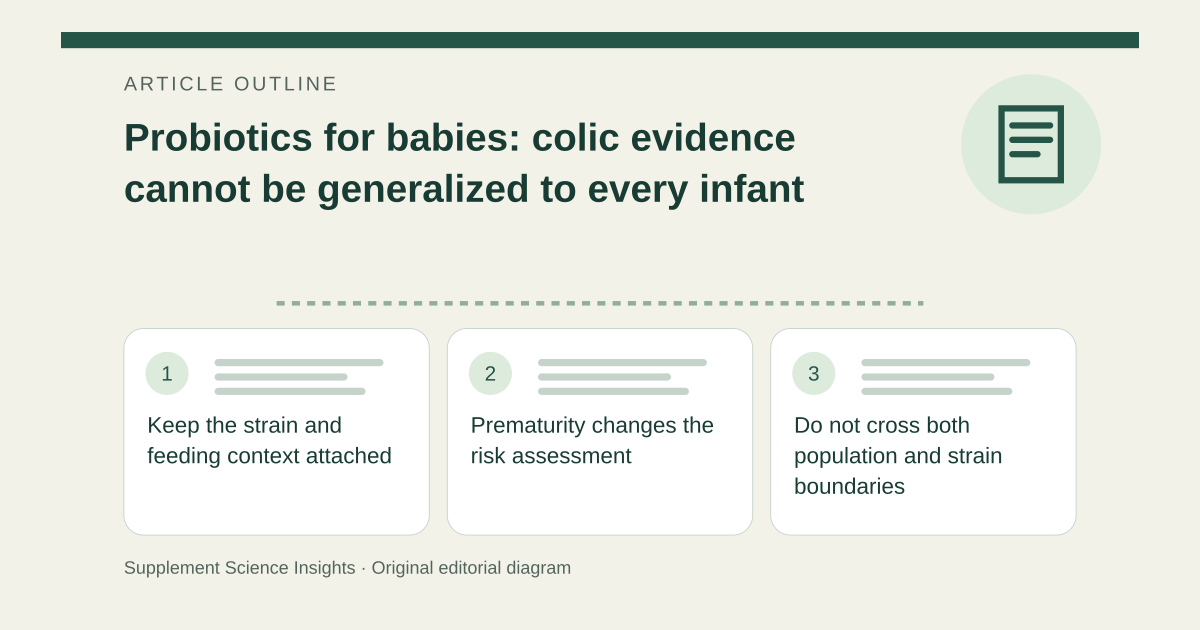
Keep the strain and feeding context attached
NCCIH summarizes a 2018 review in which Lactobacillus reuteri DSM 17938 was associated with reduced crying in infant colic, mainly among exclusively breastfed infants. A result in that setting does not establish the same effect in formula-fed infants or for every probiotic strain. [1]
Colic is also not synonymous with any unexplained distress. The underlying cause and growth or feeding concerns need pediatric assessment before a product is treated as the answer. [1]
Prematurity changes the risk assessment
The same NCCIH resource warns that severe or fatal infections have occurred in premature infants given probiotics and cites an FDA warning. Trial reports without observed harm in selected colic populations cannot erase that separate risk. [1]
A clinician should assess the exact product, infant and intended use. This article does not supply a dose, stopping age or an instruction to put an adult probiotic into infant feeds. Infant studies do not automatically establish retail-product quality or equivalence. [1]
Do not cross both population and strain boundaries
Imagine a study concerns a named strain in breastfed infants with colic. A different multi-strain product proposed for a premature infant differs in both formulation and population. The study cannot establish the second use as safe or effective.
| Detail | Interpretation |
|---|---|
| Studied strain | Keep its full identifier |
| Feeding and gestational context | Part of eligibility |
| Different product and infant group | Requires separate evidence and clinical review |
Sources for this article
- NCCIH: Probiotics—Usefulness and Safety
Source consulted: 2026-09-17. This is a reference resource, not a claim that we conducted the studies or tested a product.