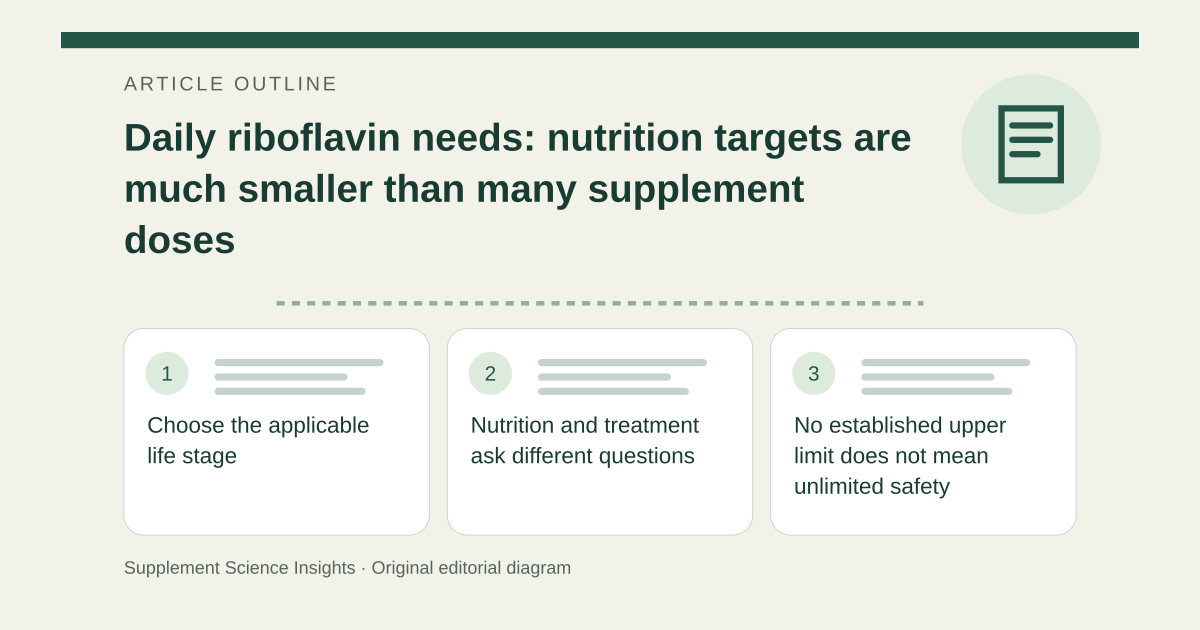
Choose the applicable life stage
ODS lists an adult RDA of 1.3 mg daily for men and 1.1 mg for women aged 19 and older. The values are 1.4 mg during pregnancy and 1.6 mg during breastfeeding. They describe usual total intake intended to meet the needs of nearly all healthy people in the group. [1]
A daily reference is not a claim that an identical amount must come from supplements. Food contributes, and a single day below a reference is not by itself a diagnosis of deficiency. [1]
Nutrition and treatment ask different questions
A dose studied for a condition such as migraine is not the dietary requirement. Conversely, a product meeting the nutritional reference does not establish efficacy for treating that condition. The population, purpose and evidence need to remain attached to the amount. [1]
This distinction is especially important with high-dose B-complex products. A multiple of the Daily Value describes a label comparison, not how much better a person’s cells will function. [1]
No established upper limit does not mean unlimited safety
The U.S. Food and Nutrition Board has not established a riboflavin upper intake limit because evidence is insufficient. ODS cautions that limited adverse-effect data are not proof that excessive intake is harmless. [1]
For an identified deficiency or a medical use, the clinician’s assessment supplies context that a general RDA table cannot. [1]
Include food before calling the RDA a shortfall
Imagine an adult woman’s usual diet supplies about 1.1 mg daily. Adding another 1.1 mg is not mathematically required merely because that number is the RDA. Whether additional intake has a purpose is a separate question.
| Detail | Interpretation |
|---|---|
| Adult men | 1.3 mg/day total-intake RDA |
| Adult women | 1.1 mg/day total-intake RDA |
| Pregnancy / breastfeeding | 1.4 / 1.6 mg/day |
Sources for this article
- NIH ODS: Riboflavin — Health Professional Fact Sheet
Source consulted: 2026-09-17. This is a reference resource, not a claim that we conducted the studies or tested a product.