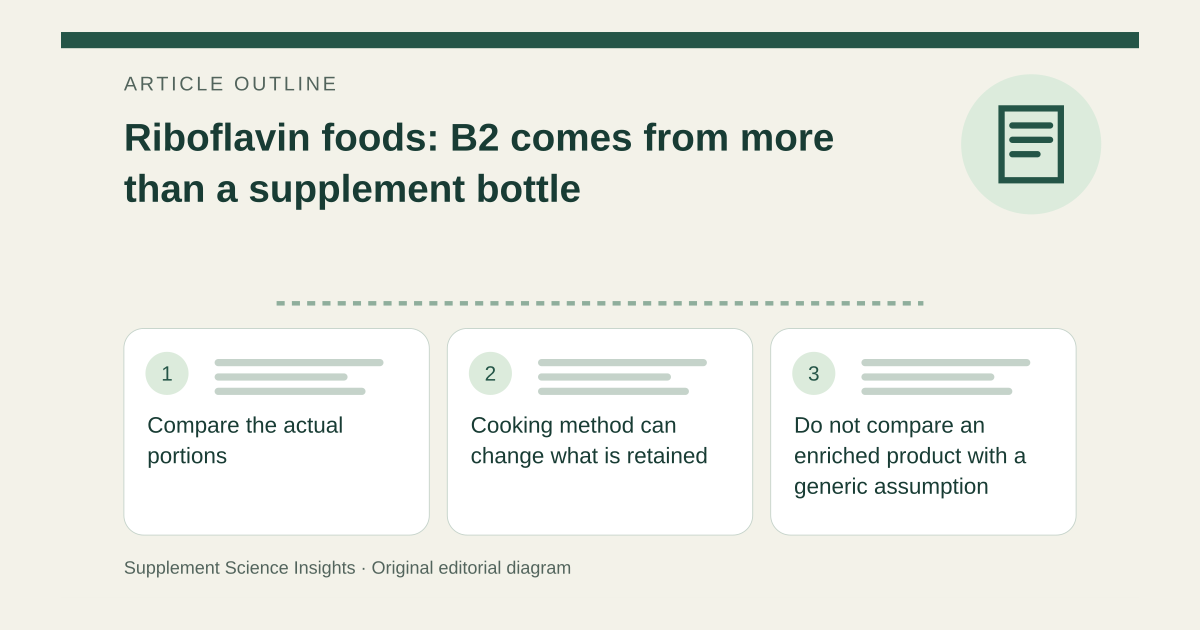
Compare the actual portions
The ODS food table lists about 0.5 mg riboflavin in a cup of 2% milk, 0.6 mg in a cup of plain fat-free yogurt and 0.3 mg in an ounce of dry-roasted almonds. These values describe specified portions, not equal masses of food. [1]
Enriched and fortified grains can also contribute. A cereal fortified to 100% of the Daily Value supplies a different amount from an unfortified cereal; the actual label is more useful than assuming all breakfast foods are equivalent. [1]
Cooking method can change what is retained
Riboflavin is water-soluble. ODS notes greater loss into cooking water with boiling than with methods such as steaming or microwaving. This does not make cooked food devoid of B2; it means preparation belongs in a food-composition comparison. [1]
An absent riboflavin entry on a food label is not proof of zero content, because routine listing is generally not required unless it is added. Use a relevant food-composition source when estimating a naturally occurring amount. [1]
Do not compare an enriched product with a generic assumption
Imagine one cereal label declares added riboflavin while another supplies no B2 information. The first provides a stated amount; the second leaves the amount uncertain. Recording zero for the second would confuse missing label information with measured absence.
| Finding | Interpretation |
|---|---|
| Declared added B2 | A usable label amount |
| No B2 line | Not proof of zero |
| Different portion | Adjust before comparing |
Sources for this article
- NIH ODS: Riboflavin
Source consulted: 2026-09-17. This is a reference resource, not a claim that we conducted the studies or tested a product.