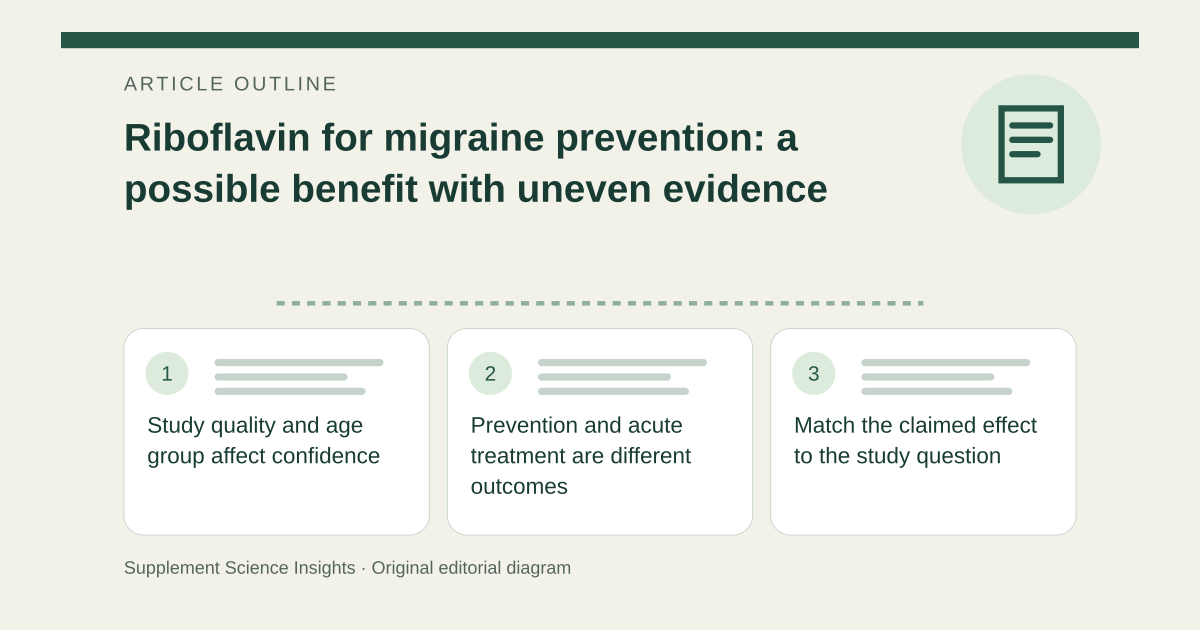
Study quality and age group affect confidence
NCCIH summarizes a review of nine studies involving 546 participants. Some used placebo-controlled designs and others did not; some found benefit and others did not. The signal appeared more favorable in adults than in children. [1]
This is a government summary of a review, not an independent reappraisal of each original trial. The mixed designs limit how confidently the findings can be generalized. [1]
Prevention and acute treatment are different outcomes
A preventive intervention aims to change future attack patterns. It is not automatically an acute pain treatment, and the usual nutritional intake reference is not a migraine-treatment prescription. [1]
Discuss the diagnosis, treatment goals and full medication or supplement list with the treating clinician. The cited summary does not establish one personally appropriate dose or a guarantee of benefit. [1]
Match the claimed effect to the study question
Imagine a product cites a prevention study but promises immediate relief during a migraine. The prevention finding does not demonstrate that different effect.
| Detail | Interpretation |
|---|---|
| Prevention | Future attack patterns |
| Acute relief | Different outcome |
| Adult evidence | Not automatically pediatric evidence |
Sources for this article
- Headaches: What You Need To Know | NCCIH
Source consulted: 2026-09-17. This is a reference resource, not a claim that we conducted the studies or tested a product.