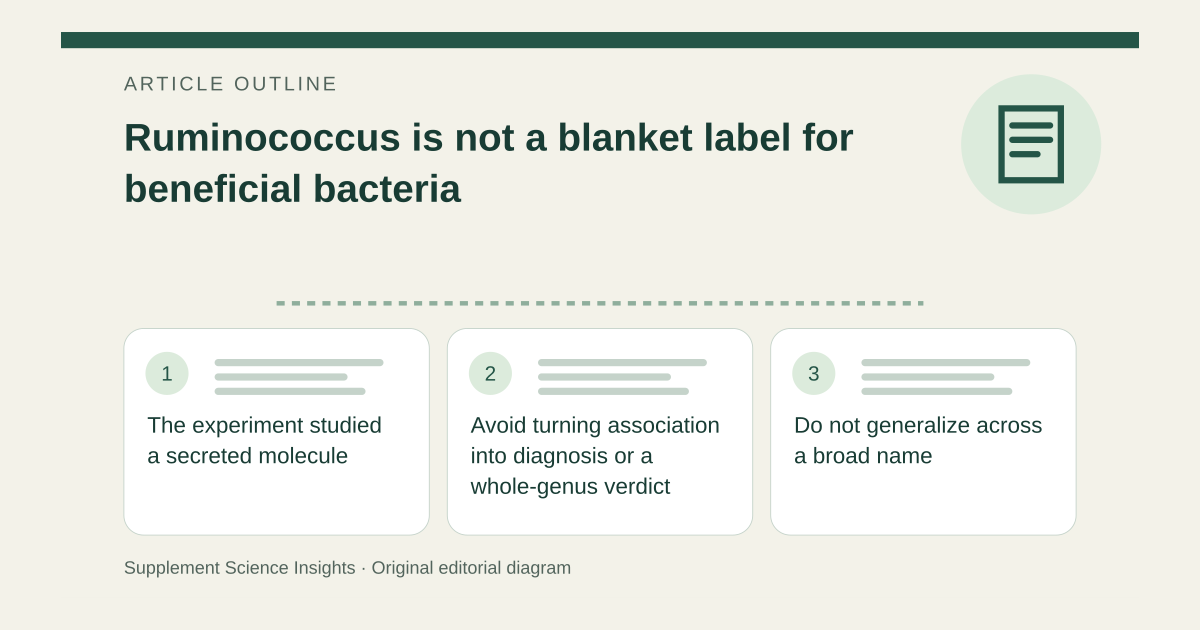
The experiment studied a secreted molecule
Researchers isolated a complex sugar polymer from R. gnavus and investigated its chemical structure. The molecule stimulated release of the inflammatory signal TNF-alpha from dendritic cells in laboratory experiments, with involvement of the TLR4 receptor. [1]
That is a mechanistic finding, not a trial showing that a probiotic improves symptoms. The authors reported no conflicts of interest. [1]
Avoid turning association into diagnosis or a whole-genus verdict
The paper discusses an association between R. gnavus and Crohn’s disease. Neither that association nor the cell experiment means that detecting the organism diagnoses Crohn’s disease in an individual. [1]
The same evidence also does not justify treating all organisms historically called Ruminococcus as harmful or beneficial. A proposed probiotic needs a defined organism, preparation, safety assessment and relevant human outcome evidence. Taxonomic names and marketing categories should not erase those distinctions. [1]
Do not generalize across a broad name
Imagine one strain produces a particular inflammatory molecule in a cell experiment. That result cannot classify every related strain or predict an individual’s disease from a stool report.
| Detail | Interpretation |
|---|---|
| Cell experiment | Mechanistic evidence |
| Disease association | Not a diagnosis |
| Probiotic benefit | Needs preparation-specific evidence |