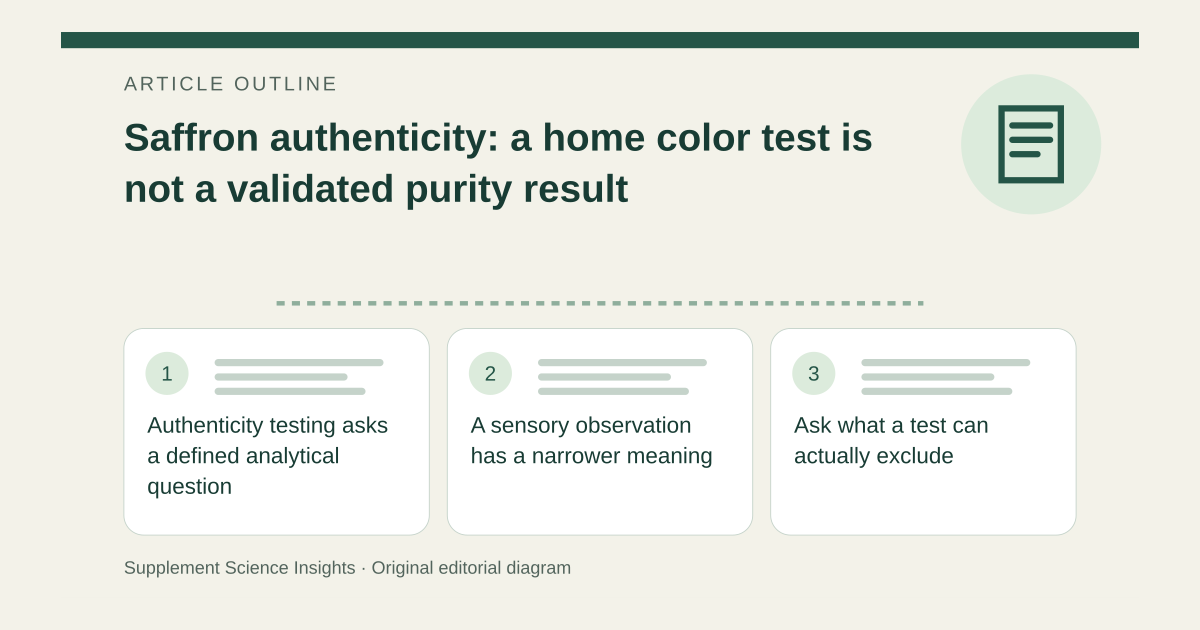
Authenticity testing asks a defined analytical question
The European Commission’s Joint Research Centre describes methods using genetic testing, marker substances and spectroscopy to investigate spice adulteration. Its qPCR work includes saffron and tests for selected plant adulterants. [1]
The target and method matter: a test designed for particular adulterants does not automatically detect every possible substitution or contaminant. [1]
A sensory observation has a narrower meaning
A home water or color observation does not provide the validation data, detection limit or target coverage of those analytical methods. Do not turn a familiar color response into a certificate of purity. [1]
For a disputed product, seek traceable identity information and relevant testing from the supplier or a competent laboratory. Even a passed authenticity test is not proof of a clinical health benefit. [1]
Ask what a test can actually exclude
Imagine a sample passes a test for one known adulterant. That result answers that test’s question; it does not prove absence of every adulterant or contaminant.
| Detail | Interpretation |
|---|---|
| Home observation | Screening clue only |
| Validated test | Defined targets and performance |
| Authenticity | Separate from clinical benefit |
Sources for this article
- Methods for the detection of adulteration of herbs and spices | Knowledge4Policy (K4P)
Source consulted: 2026-09-18. This is a reference resource, not a claim that we conducted the studies or tested a product.