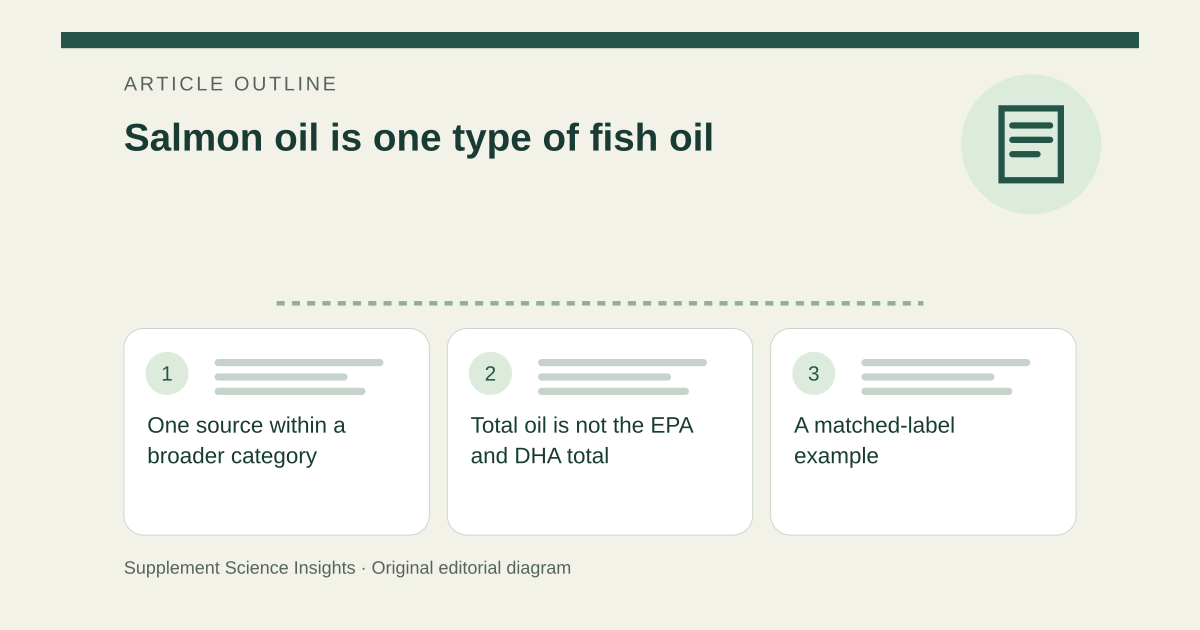
One source within a broader category
The Codex fish-oil standard describes salmon oil as derived from the Salmonidae family. Fish oils more broadly may come from different fish or shellfish sources and may be mixtures. A salmon-oil designation identifies a source category; the broad phrase fish oil is not synonymous with salmon alone. [1]
Total oil is not the EPA and DHA total
The amount of oil in a capsule includes components beyond EPA and DHA. Different products and concentrations can provide different quantities of those omega-3 fatty acids at the same total-oil weight. Read separately declared EPA and DHA amounts before concluding that one capsule provides more than another. [2]
A matched-label example
Imagine one serving of salmon oil provides EPA 120 mg and DHA 180 mg, while a different fish-oil serving provides EPA 180 mg and DHA 120 mg. Both total 300 mg EPA+DHA, despite the reversed proportions. These invented labels do not establish equivalent clinical effects, verified purity or a best brand. Source identity and outcome evidence answer different questions. [2][1]
| Hypothetical serving | EPA | DHA | EPA+DHA |
|---|---|---|---|
| Salmon oil | 120 mg | 180 mg | 300 mg |
| Other fish oil | 180 mg | 120 mg | 300 mg |
Sources for this article
- Codex CXS329-2017: Standard for Fish Oils, amended2024
Source consulted: 2026-09-20. This is a reference resource, not a claim that we conducted the studies or tested a product. - Omega-3 Fatty Acids - Health Professional Fact Sheet
Source consulted: 2026-09-20. This is a reference resource, not a claim that we conducted the studies or tested a product.