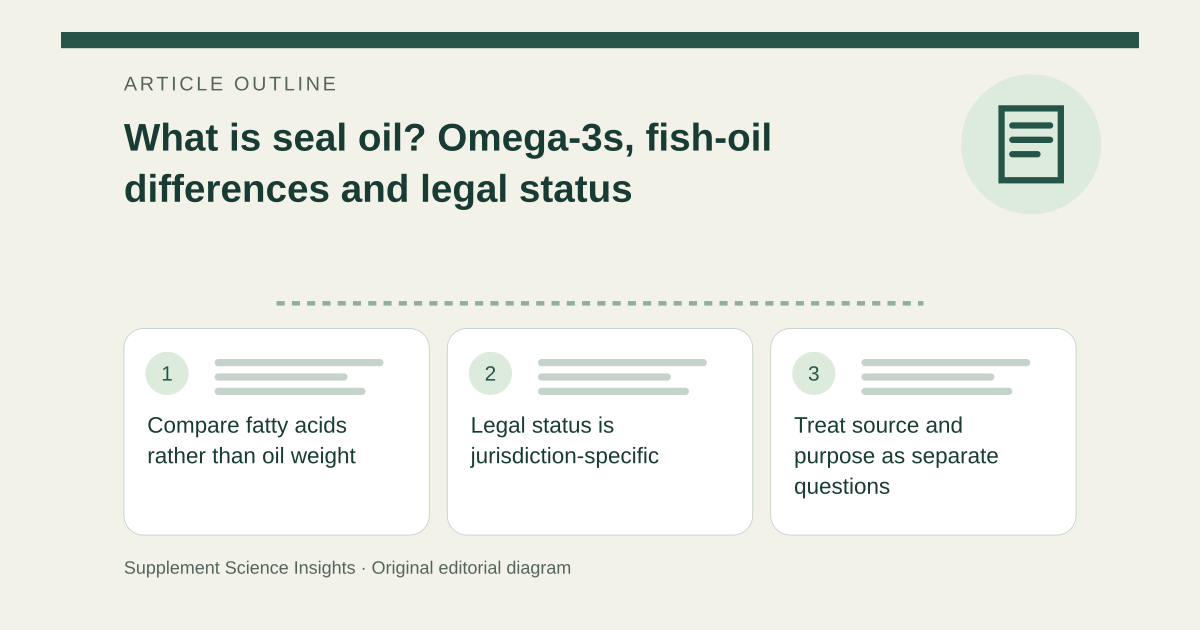
Compare fatty acids rather than oil weight
Health Canada’s monograph identifies seal species and blubber as the source, and covers naturally occurring EPA, DHA and DPA. A total oil amount does not disclose each fatty acid. Composition alone does not demonstrate superior clinical outcomes over a fish-oil product with a different profile. [1]
Legal status is jurisdiction-specific
The U.S. Marine Mammal Protection Act generally prohibits taking and importing marine mammals and their products, with specified exceptions. A retail website or Canadian product status does not establish an applicable U.S. exception. Confirm requirements with the relevant authority before buying or carrying seal products across borders. [2]
Treat source and purpose as separate questions
Imagine two oils advertise the same total milligrams, but only one discloses EPA and DHA. That is insufficient for a matched nutrient comparison. Consider the reason for use, exact fatty-acid amounts, product quality and legal supply; the presence of DPA is not by itself proof of a better treatment. [1][3]
| Detail | Meaning |
|---|---|
| Oil milligrams | Not individual omega-3 amounts |
| Seal source | Marine mammal blubber |
| Foreign licence | Not import permission |
Sources for this article
- Temporary title
Source consulted: 2026-09-21. This is a reference resource, not a claim that we conducted the studies or tested a product. - Marine Mammal Protection Act | NOAA Fisheries
Source consulted: 2026-09-21. This is a reference resource, not a claim that we conducted the studies or tested a product. - Dietary Supplements: What You Need to Know - Consumer
Source consulted: 2026-09-21. This is a reference resource, not a claim that we conducted the studies or tested a product.