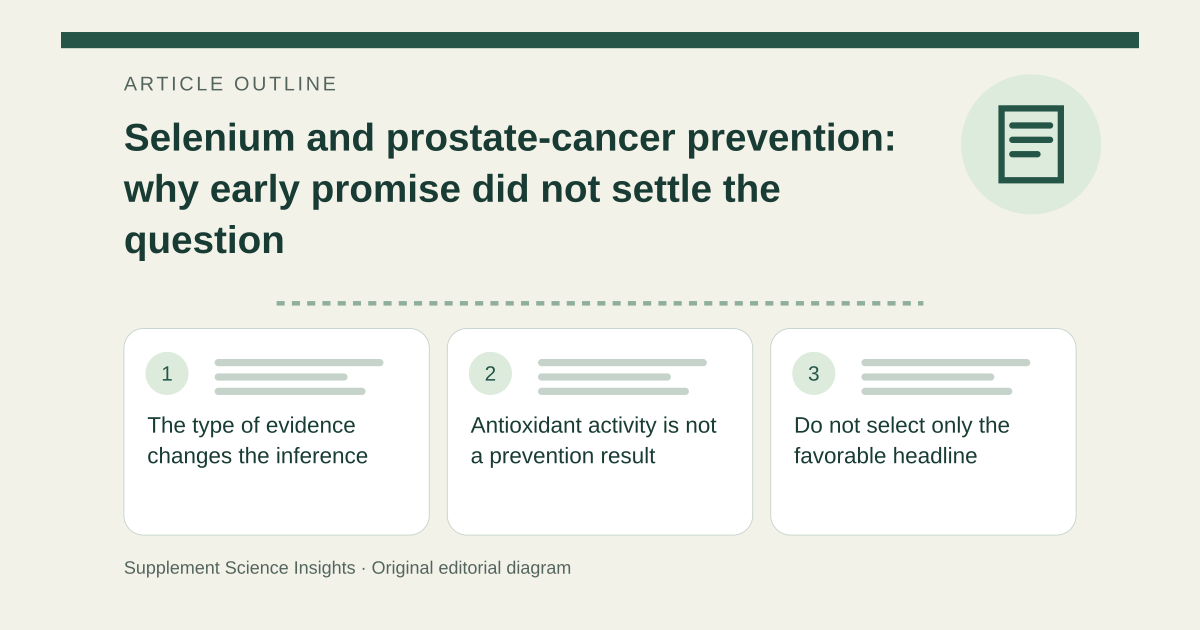
The type of evidence changes the inference
Some observational studies linked higher selenium status with lower cancer risk, and an early trial reported a prostate-cancer finding that encouraged further research. ODS reports that subsequent randomized trials did not show that selenium supplements reduce prostate cancer or other cancer risk. [1]
An association between nutritional status and disease is not the same as evidence that adding a supplement prevents disease. Other characteristics of participants and their diets can contribute to observational findings. [1]
Antioxidant activity is not a prevention result
Selenium has roles in antioxidant systems and other biological processes relevant to cancer research. Those mechanisms support hypotheses, but they do not replace trials measuring cancer outcomes. [1]
The existence of a normal nutrient function also does not establish a benefit from extra intake after adequacy is reached. A supplement claim should specify the population, preparation and endpoint rather than rely on the word antioxidant. [1]
Do not select only the favorable headline
Imagine an advertisement cites an early positive finding but omits later randomized results. A reader needs the broader evidence pattern to assess whether the claim remains supported.
This example does not prove that every trial is equivalent. It shows why one selected result cannot stand in for the current authoritative synthesis.
| Item | Meaning |
|---|---|
| Observational association | Does not isolate the effect of a supplement |
| Later randomized trials | Must remain part of the assessment |
| Biological plausibility | Not proof of fewer cancer diagnoses |
A prevention claim still needs a favorable balance
Selenium is essential, but excessive intake can cause harm, including selenosis. A high-dose product should not be treated as a risk-free precaution against prostate cancer. [1]
This page does not recommend selenium for cancer prevention or treatment. Questions during cancer care should be discussed with the treating team, with the full supplement list available. [1]
Sources for this article
- NIH ODS — Selenium: Health Professional Fact Sheet
Source consulted: 2026-09-17. This is a reference resource, not a claim that we conducted the studies or tested a product.