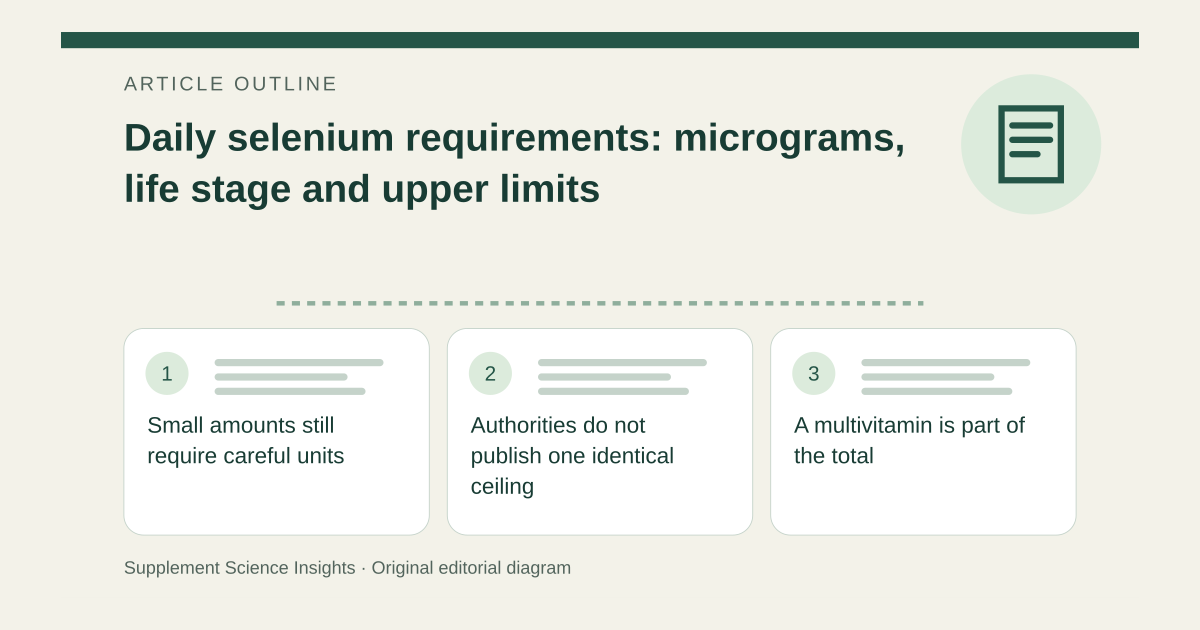
Small amounts still require careful units
The U.S. recommended selenium intake is 55 micrograms per day for adults and adolescents aged 14–18. It rises to 60 micrograms in pregnancy and 70 micrograms during breastfeeding. These are total dietary intake references, not extra amounts to add to an existing diet. [1]
Micrograms and milligrams differ by a factor of 1,000. A label or calculation that loses the unit can therefore turn a small nutrient amount into a very different exposure. Keep the amount and unit together throughout a comparison. [1]
Authorities do not publish one identical ceiling
ODS lists the U.S. Food and Nutrition Board adult upper limit as 400 micrograms daily from food and supplements. It also reports the European Food Safety Authority’s 2023 adult upper limit of 255 micrograms, including pregnancy and breastfeeding. [1]
These limits reflect safety assessments, not a recommended intake range. Reporting either number without its authority and population can be misleading, especially when someone interprets the larger number as a target. [1]
A multivitamin is part of the total
Imagine an adult sees the 55-microgram allowance and already takes a multivitamin containing that amount. Their food intake has not disappeared, so a second 55-microgram product is not automatically required.
A useful review counts all sources and the reason for supplementation rather than adding the full reference repeatedly.
| Item | Meaning |
|---|---|
| 55 micrograms | Adult recommended total intake |
| 400 micrograms, U.S. FNB | Adult upper limit, not a target |
| 255 micrograms, EFSA 2023 | A different authority’s adult upper limit |
Excess can damage hair and nails
Chronically high selenium intake can cause selenosis, including hair loss and brittle or lost nails. Organic and inorganic forms can both cause harm when intake is excessive. [1]
A diagnosed deficiency or specialist treatment needs an individualized plan. The healthy-person reference table does not select a therapeutic dose or establish that more selenium improves thyroid function. [1]
Sources for this article
- NIH ODS — Selenium: Health Professional Fact Sheet
Source consulted: 2026-09-17. This is a reference resource, not a claim that we conducted the studies or tested a product.