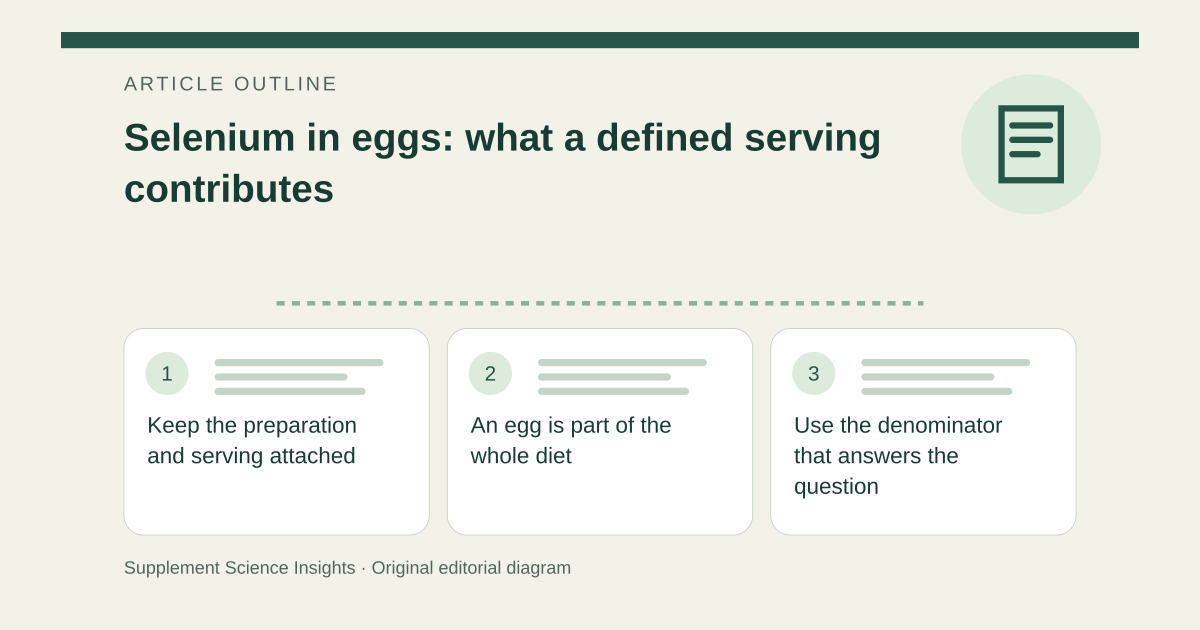
Keep the preparation and serving attached
The ODS food table lists 15 micrograms of selenium for one large hard-boiled egg. Against the adult 55-microgram reference, that is approximately 27%. The stated serving matters when using the number. [1]
A smaller egg, another preparation or a specially enriched product should not automatically be assigned that exact value. Food-composition data help estimate intake; they are not a laboratory measurement of the egg on a particular plate. [1]
An egg is part of the whole diet
Eggs are among the foods that contribute selenium, alongside seafood, meat, poultry, grains and other sources. One food does not need to supply the entire daily allowance for the diet to be adequate. [1]
The daily reference also includes supplements. Someone using a multivitamin should not ignore that contribution when reviewing total selenium exposure. [1]
Use the denominator that answers the question
Imagine a meal includes two large hard-boiled eggs. Using the table estimate gives about 30 micrograms of selenium, or roughly 55% of a 55-microgram adult reference.
That arithmetic describes the two listed servings. It does not prove exact intake, absorbed amount or a need to obtain the remaining amount from a capsule. Other meals still contribute.
| Item | Meaning |
|---|---|
| One listed large hard-boiled egg | About 15 micrograms |
| Two equivalent servings | About 30 micrograms by arithmetic |
| 30 divided by 55 | About 55% of the adult reference |
Enriched-food claims need their own information
A product promoted as selenium enriched needs composition information for that actual product. The ordinary-egg estimate does not verify its claim, and a higher amount is not automatically more beneficial. [1]
Excess selenium can be harmful. Use enriched foods and supplements within a review of total intake rather than treating the word enriched as a reason to consume an unlimited amount. [1]
Sources for this article
- NIH ODS — Selenium: Health Professional Fact Sheet
Source consulted: 2026-09-17. This is a reference resource, not a claim that we conducted the studies or tested a product.