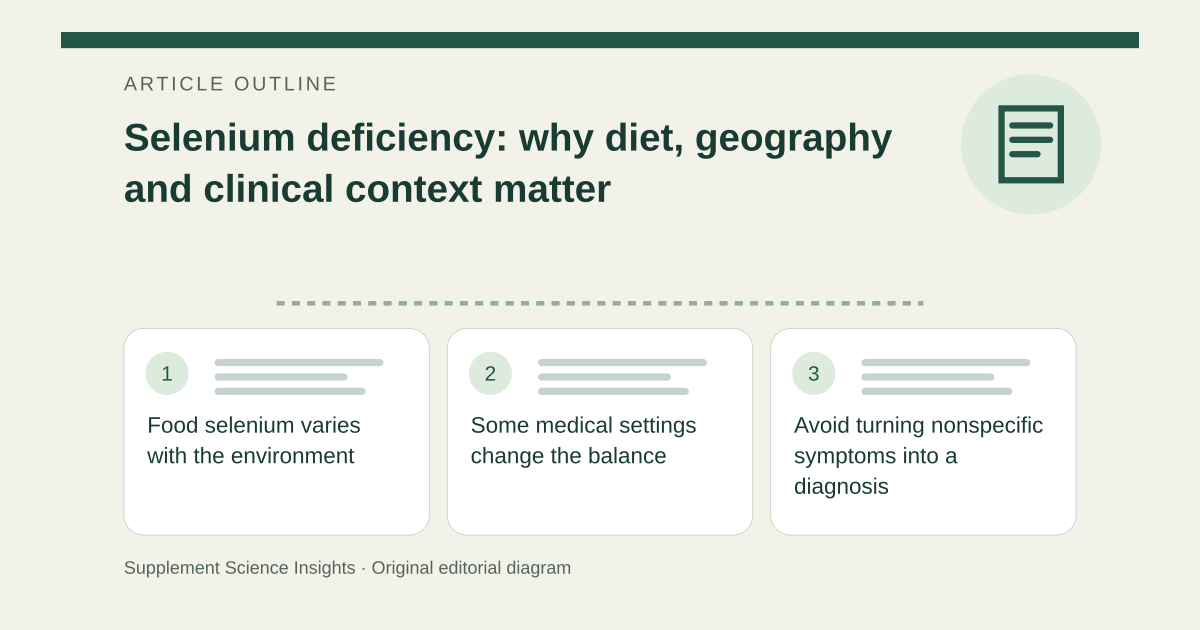
Food selenium varies with the environment
Selenium in plant foods depends partly on the amount and form in soil, along with factors such as soil chemistry. Some regions therefore produce foods with lower selenium concentrations than others. [1]
A dietary pattern and the origin of its foods matter more than a single food name. ODS identifies people in low-selenium regions as a risk group, but location or diet alone does not diagnose an individual deficiency. [1]
Some medical settings change the balance
People undergoing long-term hemodialysis often have lower selenium concentrations. Dialysis can remove selenium, while appetite and dietary restrictions can also reduce intake. These factors make the clinical setting important. [1]
That observation is not a universal instruction to add selenium during dialysis. The renal team needs to assess the whole nutritional and treatment picture before selecting replacement. [1]
Avoid turning nonspecific symptoms into a diagnosis
ODS states that selenium deficiency by itself rarely causes overt illness. It describes associations with endemic conditions such as Keshan disease in particular low-selenium settings, where additional factors are relevant. [1]
Those population findings should not be used to diagnose ordinary fatigue or heart symptoms as selenium deficiency. Laboratory information and the clinical history are needed to assess whether selenium is involved. [1]
A regional risk is a reason to ask, not assume
Imagine someone eats a restricted diet using mostly locally grown foods in a low-selenium area. The pattern raises an adequacy question, but does not identify their blood level or the correct supplement amount.
A food review and appropriate clinical assessment can address that question without assuming that any vague symptom proves a deficiency.
| Item | Meaning |
|---|---|
| Food pattern and origin | Help assess likely intake |
| Dialysis or other clinical context | Can alter nutrient balance |
| Symptoms alone | Do not identify selenium deficiency |
Sources for this article
- NIH ODS — Selenium: Health Professional Fact Sheet
Source consulted: 2026-09-17. This is a reference resource, not a claim that we conducted the studies or tested a product.