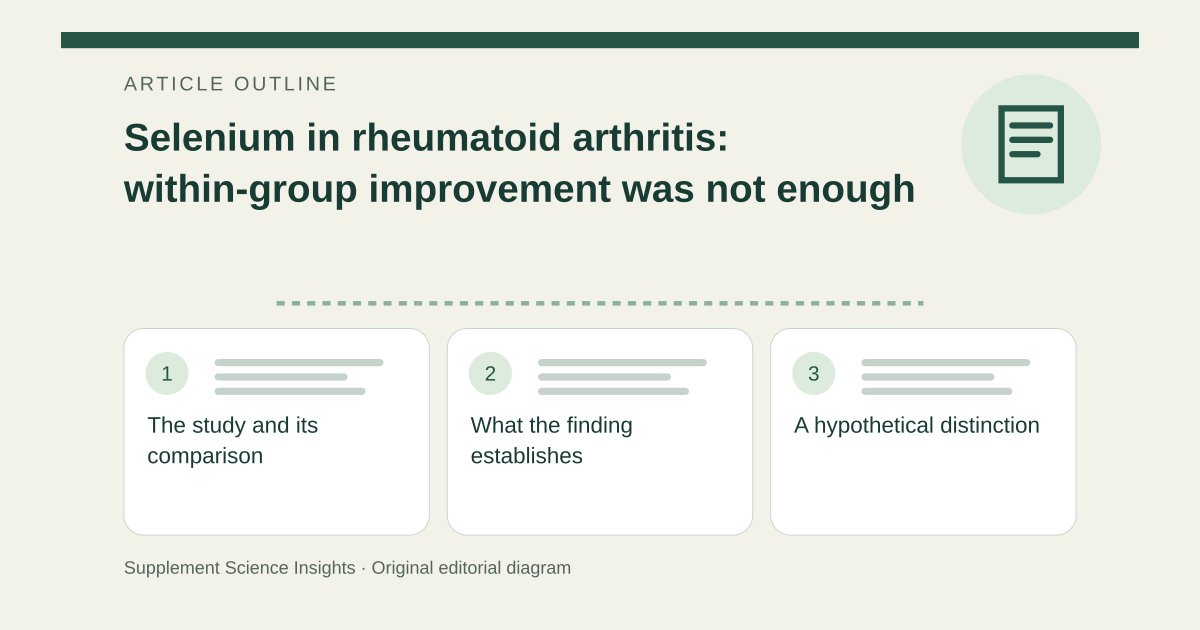
The study and its comparison
A blinded twelve-week trial randomized 59 people with rheumatoid arthritis to selenium or placebo. Investigators assessed disease activity, inflammatory markers and several metabolic measures. [1]
Disease-activity scores fell in both groups without a significant between-group difference. A borderline unadjusted CRP comparison was no longer significant after accounting for baseline values. Other selected markers improved within the selenium group, but their between-group confidence intervals included no effect. [1]
What the finding establishes
A change from a group’s own baseline does not establish superiority over control. Small samples and multiple biomarker comparisons leave substantial uncertainty. Funding and conflicts were not established from the abstract. The authors’ favorable interpretation of selected markers should therefore be separated from demonstrated clinical benefit or a reason to replace arthritis treatment. [1]
A hypothetical distinction
Imagine both groups improve and their difference remains uncertain. Reporting only one group’s before-and-after change overstates the evidence.
| Detail | Interpretation |
|---|---|
| Measured outcome | Keep the endpoint specific |
| Study preparation | Not every retail product |
| Remaining uncertainty | Not resolved by a mechanism |
Sources for this article
- Effects of Selenium Supplementation on the Indices of Disease Activity, Inflammation and Oxidative Stress in Patients with Rheumatoid Arthritis: a Randomized Clinical Trial.
Source consulted: 2026-09-19. This is a reference resource, not a claim that we conducted the studies or tested a product.