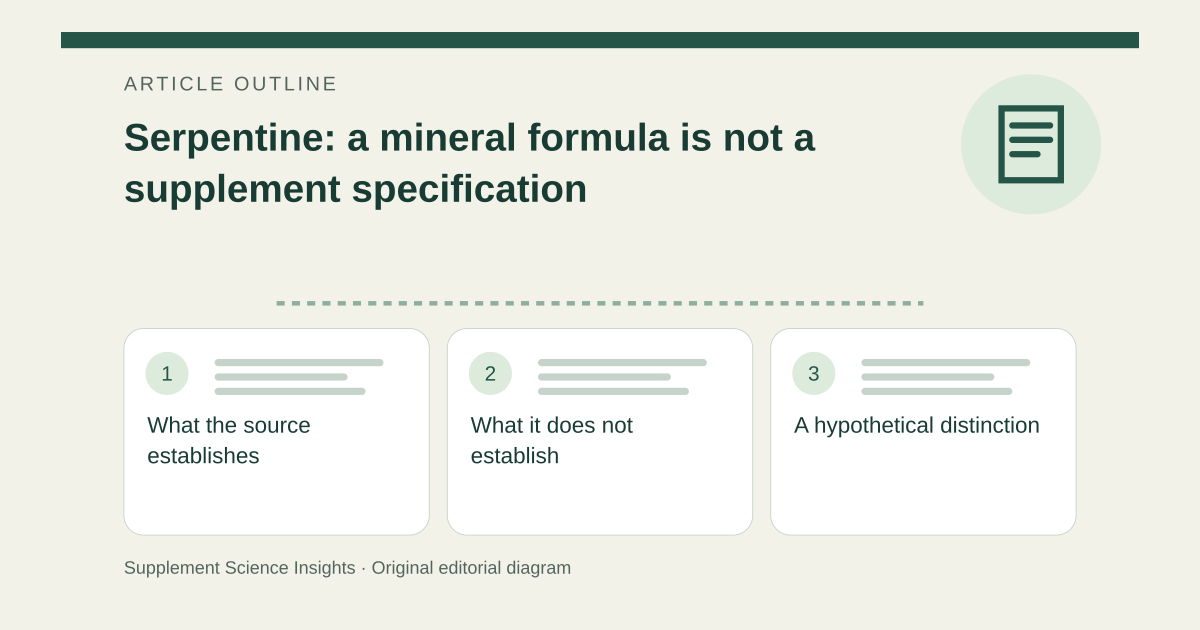
What the source establishes
The serpentine entry gives the formula Mg3Si2O5(OH)4 and describes a hydrous alteration mineral. Small amounts of iron and nickel may also be present. [1]
The sample description discusses spectral features potentially associated with iron. It also acknowledges that some features could arise from residual unaltered amphibole rather than the serpentine itself. [1]
What it does not establish
The record reports no available X-ray-diffraction analysis and no compositional-analysis method for this entry. A formula therefore should not be read as a complete purity certificate. Geological magnesium content does not establish suitability as a nutritional ingredient. [1]
A hypothetical distinction
Imagine a specimen matches a mineral family while containing a second mineral. Its ideal formula does not describe every component of the sample.
| Detail | Interpretation |
|---|---|
| Ideal formula | Mineral model |
| Spectral feature | Interpretation can be uncertain |
| Nutritional suitability | Not established |
Sources for this article
- USGS Spectroscopy Lab - Clark et. al. 2003 Spectral Library splib05a
Source consulted: 2026-09-19. This is a reference resource, not a claim that we conducted the studies or tested a product.