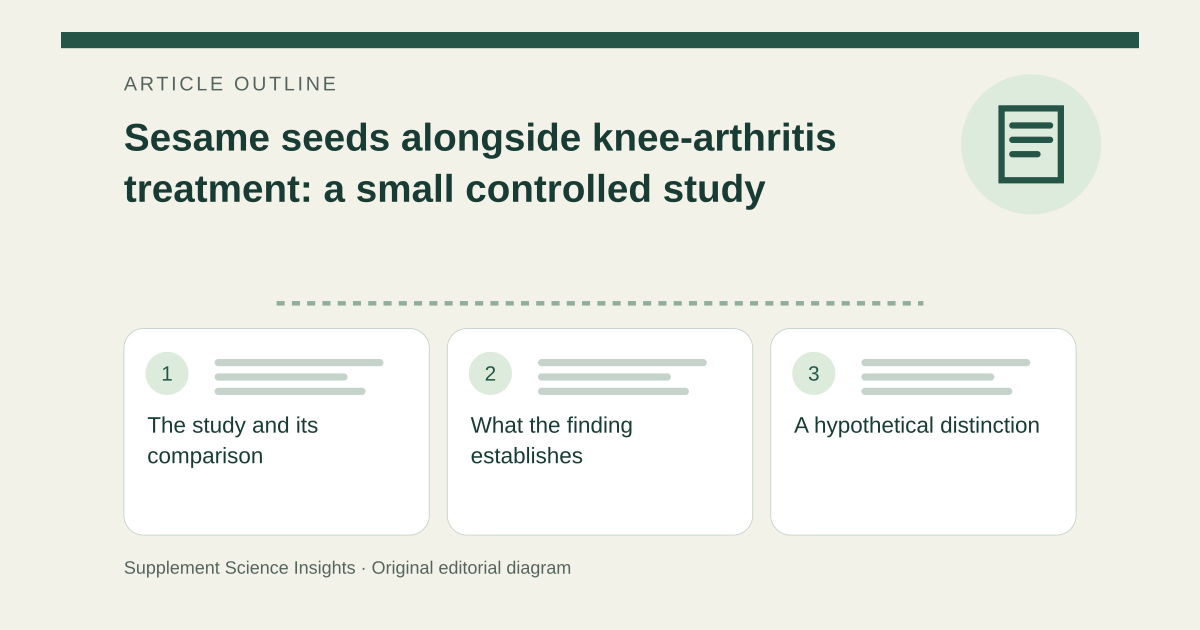
The study and its comparison
Fifty people with knee osteoarthritis were divided into two groups. Both received standard treatment; one also consumed forty grams of sesame seeds daily for two months. [1]
Pain and selected function measures differed between groups after treatment, favoring the sesame group. Some measures improved in both groups from baseline. The abstract does not establish the details of allocation concealment or a matched food placebo. [1]
What the finding establishes
A small food-addition study is vulnerable to expectation and dietary differences, especially when masking is uncertain. It cannot identify one fatty acid as the active constituent or show that cartilage regenerated. Funding and conflicts were not established from the abstract. The findings concern an adjunct to standard treatment, not sesame replacing that treatment. [1]
A hypothetical distinction
Imagine adding a food changes symptoms. Without isolating its constituents, attributing the effect to one fat goes beyond the comparison.
| Detail | Interpretation |
|---|---|
| Measured outcome | Keep the endpoint specific |
| Study preparation | Not every retail product |
| Remaining uncertainty | Not resolved by a mechanism |
Sources for this article
- Effects of sesame seed supplementation on clinical signs and symptoms in patients with knee osteoarthritis.
Source consulted: 2026-09-19. This is a reference resource, not a claim that we conducted the studies or tested a product.