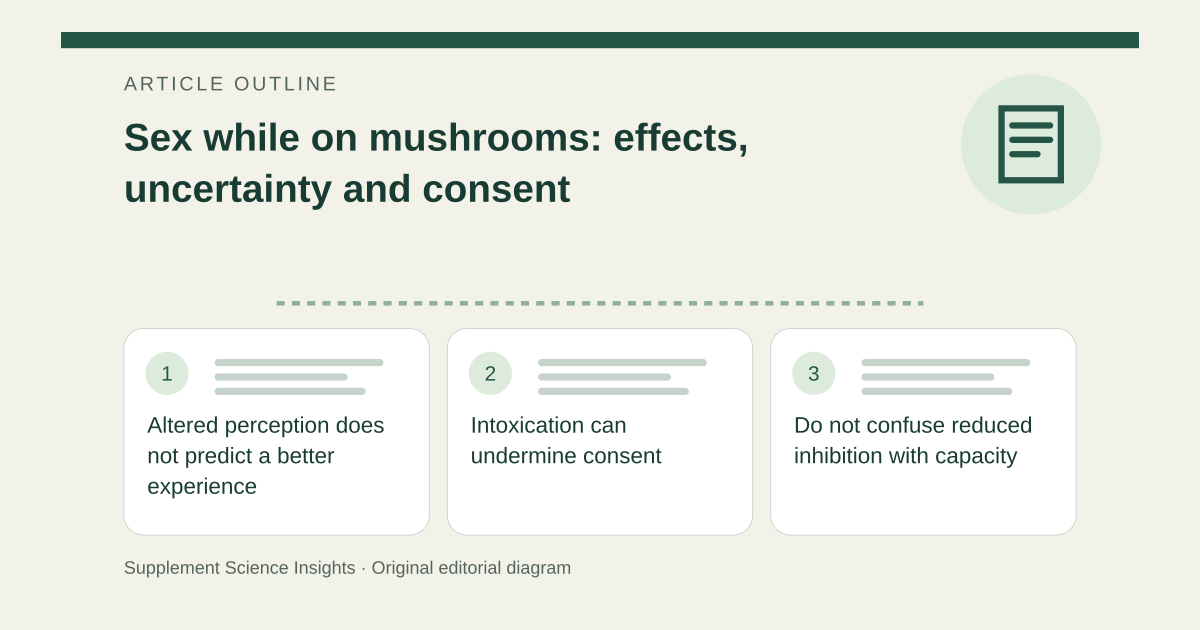
Altered perception does not predict a better experience
Some people describe greater connection during psychedelic experiences, while others experience fear, distraction or physical discomfort. General reports of connection are not controlled evidence that psilocybin improves arousal, orgasm or relationship quality. [1][2]
Intoxication can undermine consent
Consent requires a free, informed and ongoing choice. RAINN cautions that intoxication can make a person unable to consent. A prior agreement or existing relationship is not a reason to proceed when someone cannot understand, communicate or freely change their mind. [3]
Do not confuse reduced inhibition with capacity
Strong emotion, a sense of closeness or apparent enthusiasm during an altered state does not establish clear judgment. Avoid pressure and postpone activity if there is uncertainty about capacity or willingness. [3][2]
Choose a sober conversation about boundaries
Imagine partners discussed intimacy earlier, but one becomes confused or frightened during a trip. Stop and focus on safety and support. Discuss preferences again when both can make and communicate an unimpaired decision. [3]
| Situation | Appropriate response |
|---|---|
| Earlier agreement | Does not override current inability |
| Confusion or fear | Stop and provide support |
| Uncertain capacity | Postpone sexual activity |
| Performance claim | Ask for relevant clinical evidence |
Sources for this article
- Psilocybin for Mental Health and Addiction: What You Need To Know | NCCIH
Source consulted: 2026-09-21. This is a reference resource, not a claim that we conducted the studies or tested a product. - Psychedelic and Dissociative Drugs | National Institute on Drug Abuse (NIDA)
Source consulted: 2026-09-21. This is a reference resource, not a claim that we conducted the studies or tested a product. - Consent 101: Respect, Boundaries, and Building Trust - RAINN
Source consulted: 2026-09-21. This is a reference resource, not a claim that we conducted the studies or tested a product.