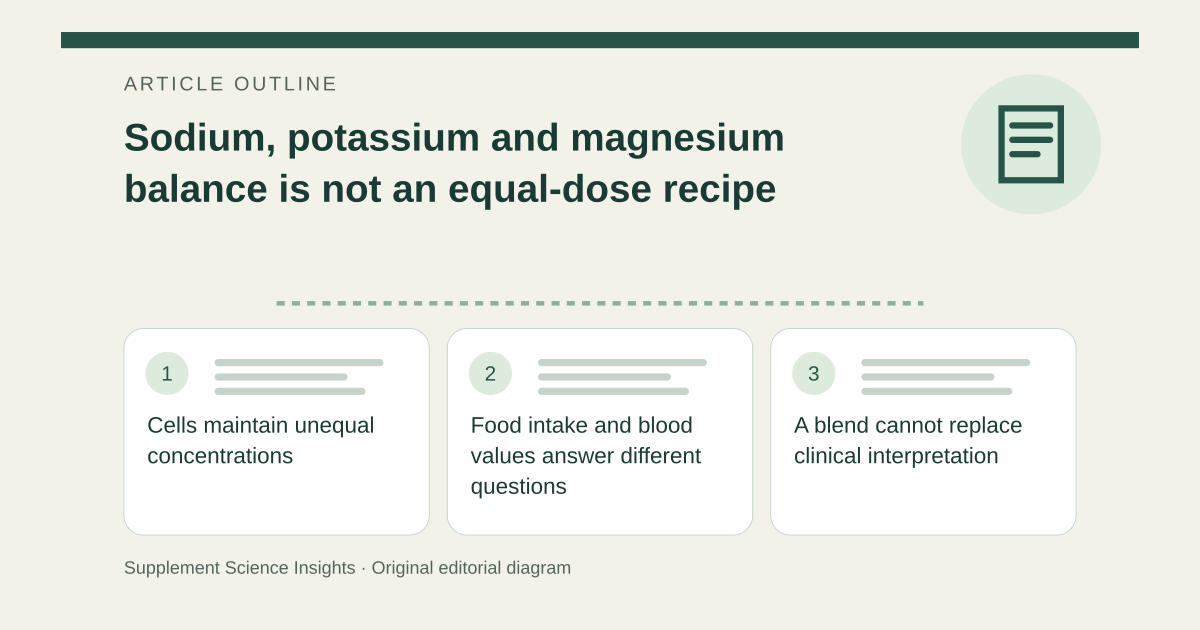
Cells maintain unequal concentrations
Potassium is concentrated mainly inside cells, while sodium is central to extracellular fluid regulation. The sodium-potassium gradient supports nerve and muscle function. Magnesium participates in many enzyme and physiological processes. Balance therefore means regulated relationships, not equal concentrations or equal grams consumed. [1][2]
Food intake and blood values answer different questions
The kidneys and other regulatory systems help maintain electrolyte levels. A symptom such as a cramp does not identify which electrolyte, if any, is low. Kidney disease and medicines can change the safety of adding potassium or magnesium, even when a product is marketed as a hydration blend. [1][2]
A blend cannot replace clinical interpretation
Imagine someone sees a low laboratory potassium result and buys a three-mineral powder. Its magnesium and sodium content does not establish the correct potassium treatment or explain the low result. Clinical abnormalities need interpretation, while everyday dietary planning uses nutrient-specific intake guidance rather than a single balancing ratio. [1][2]
| Illustrative situation | Relevant distinction |
|---|---|
| Unequal cell concentrations | Normal physiological organization |
| Cramp alone | Does not identify a deficiency |
| Abnormal blood electrolyte | Requires cause-specific assessment |
Sources for this article
- Potassium - Health Professional Fact Sheet
Source consulted: 2026-09-20. This is a reference resource, not a claim that we conducted the studies or tested a product. - Magnesium - Health Professional Fact Sheet
Source consulted: 2026-09-20. This is a reference resource, not a claim that we conducted the studies or tested a product.