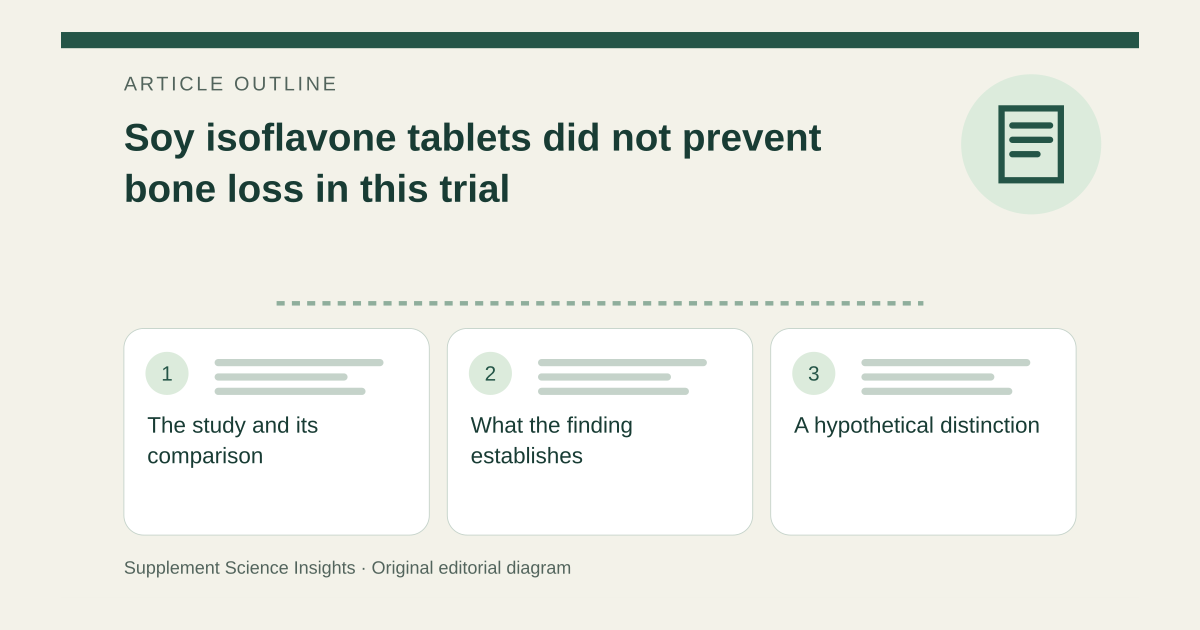
The study and its comparison
A blinded trial compared soy isoflavone tablets with placebo in women within five years of menopause. Reported groups included 122 and 126 women; the primary outcomes were bone-density changes at the spine and hip. [1]
Bone density declined similarly in both groups over two years. The trial did not show prevention of menopausal symptoms, and more participants taking soy tablets reported hot flashes and constipation. [1]
What the finding establishes
A nutrient’s interaction with estrogen-related biology does not establish a clinical replacement for hormone treatment. This study tested a particular high-amount isoflavone preparation, not ordinary soy foods or every product marketed for balance. Funding and conflicts were not established from the abstract. A null bone-density comparison also should not be reframed as demonstrated fracture protection. [1]
A hypothetical distinction
Imagine an extract has a plausible hormonal mechanism but does not preserve bone density. The mechanism does not override the trial.
| Detail | Interpretation |
|---|---|
| Measured outcome | Keep the endpoint specific |
| Study preparation | Not every retail product |
| Remaining uncertainty | Not resolved by a mechanism |
Sources for this article
- Soy isoflavones in the prevention of menopausal bone loss and menopausal symptoms: a randomized, double-blind trial.
Source consulted: 2026-09-19. This is a reference resource, not a claim that we conducted the studies or tested a product.