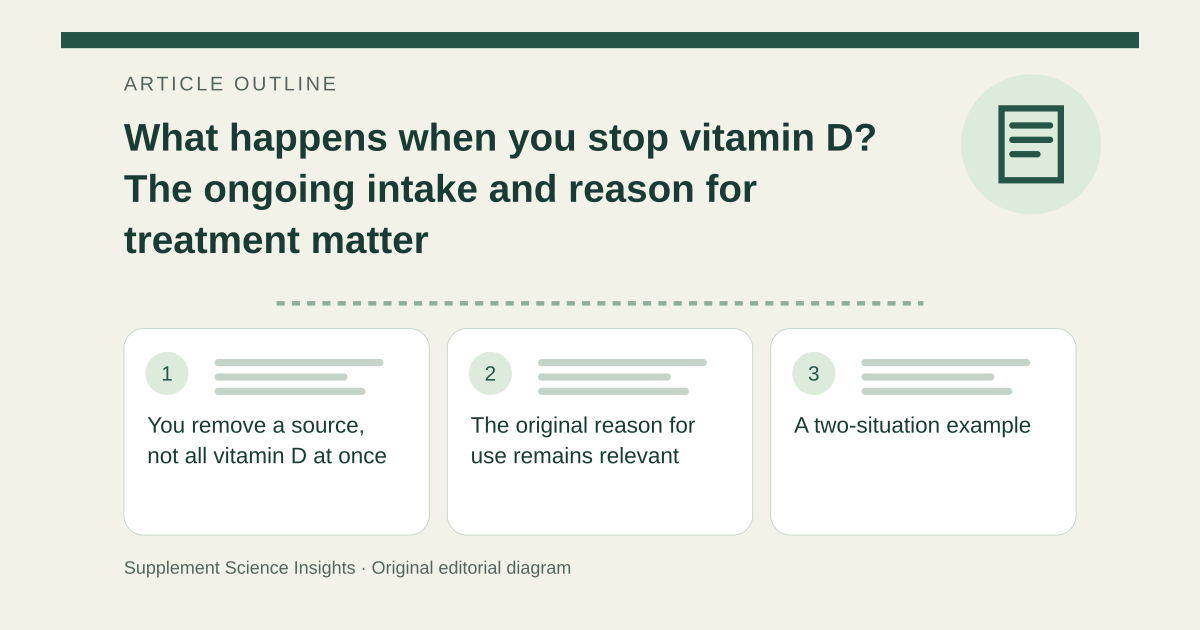
You remove a source, not all vitamin D at once
Vitamin D can come from food, supplements and skin synthesis. Ending a supplement changes only one component of that supply. NIH ODS describes circulating 25(OH)D as having a half-life of about 15 days, but this is not a precise countdown to deficiency after the last tablet. Starting status and continuing sources differ. [1]
The original reason for use remains relevant
If a supplement was treating deficiency or compensating for malabsorption, the underlying problem may persist after it is stopped. If it duplicated other sources, the consequence may be different. A symptom change cannot reliably measure vitamin D status, and no universal number of days determines whether a person needs to restart. [1]
A two-situation example
Imagine one person stops an extra bottle while continuing an adequate prescribed regimen, and another stops their only replacement despite ongoing malabsorption. These are not equivalent decisions. Discuss changes to prescribed treatment and any needed follow-up with the clinician rather than applying the same stopping rule to both. [1]
| Hypothetical change | What must be reviewed |
|---|---|
| Remove a duplicate product | Remaining total intake |
| Stop deficiency treatment | Cause, regimen and follow-up |
| Symptoms after stopping | Not a vitamin D measurement |
Sources for this article
- Vitamin D - Health Professional Fact Sheet
Source consulted: 2026-09-20. This is a reference resource, not a claim that we conducted the studies or tested a product.