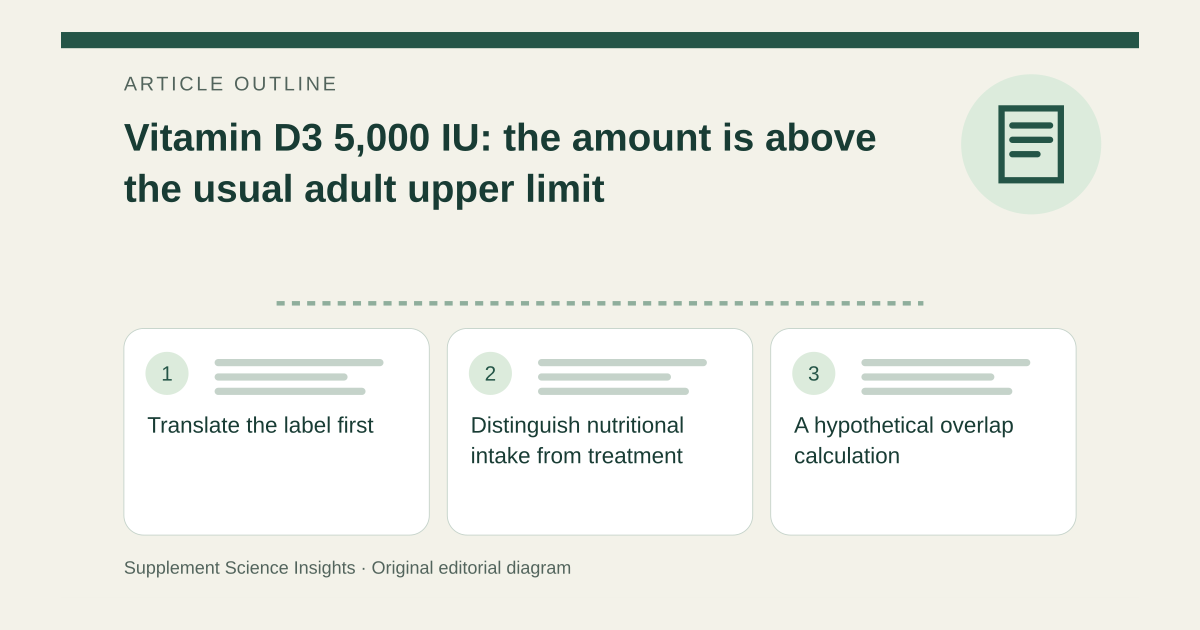
Translate the label first
Vitamin D helps maintain calcium absorption and bone mineralization. A 5,000 IU capsule supplies 125 mcg, using the NIH ODS conversion of 40 IU per mcg. The nutrient has the same normal functions at this strength; the larger number does not create a special additional function or establish a benefit for someone already obtaining enough. [1]
Distinguish nutritional intake from treatment
The general U.S. RDA is 600 IU for adults through age 70 and 800 IU thereafter. The adult upper limit is 4,000 IU daily from total intake; it is not a target. Clinicians may use different amounts for a specific deficiency or condition, with an appropriate regimen and follow-up. A single 5,000 IU exposure is not automatically a diagnosis of toxicity, but taking it repeatedly without a clear indication exceeds that routine limit. [1]
A hypothetical overlap calculation
If a 5,000 IU product and a 1,000 IU multivitamin are taken on the same day, the supplement total is 6,000 IU, or 150 mcg, before food. This arithmetic is not a dosing plan. Review the intended schedule and all products with the clinician rather than treating each bottle as a separate allowance. [1]
| Hypothetical vitamin D label | Equivalent amount |
|---|---|
| 5,000 IU | 125 mcg |
| 5,000 plus1,000 IU | 150 mcg total |
Sources for this article
- Vitamin D - Health Professional Fact Sheet
Source consulted: 2026-09-20. This is a reference resource, not a claim that we conducted the studies or tested a product.