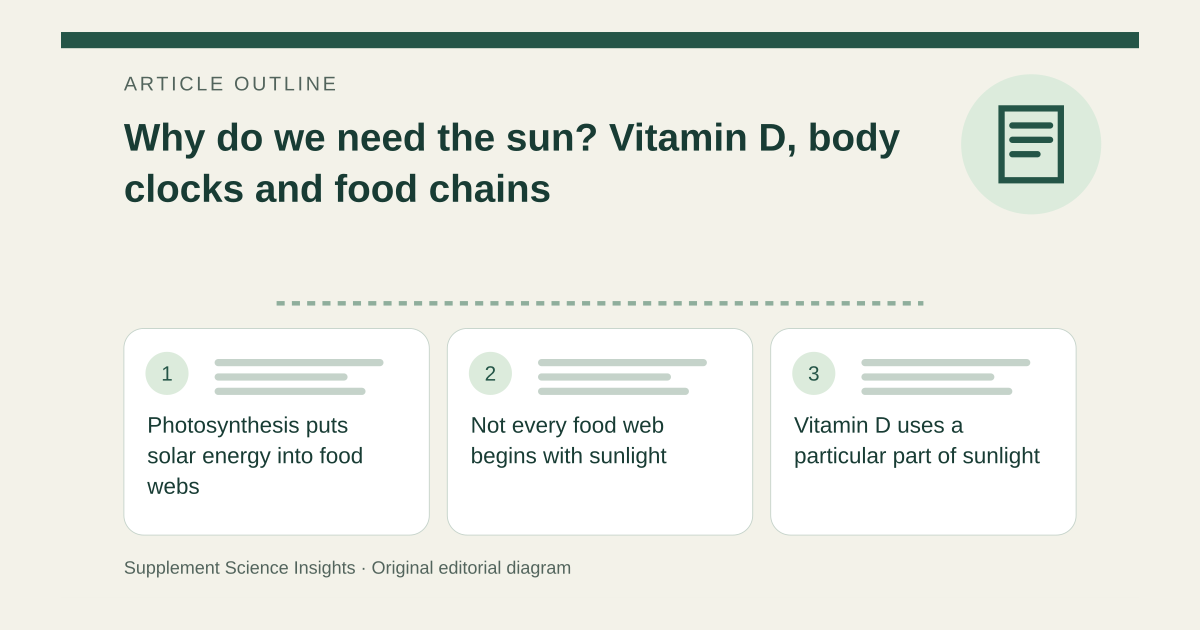
Photosynthesis puts solar energy into food webs
Plants and other photosynthetic organisms use light energy to make organic compounds from carbon dioxide and water. Other organisms obtain energy by consuming these producers or organisms that ate them. This explains why sunlight supports much of the food supply even for animals that do not photosynthesize. [1]
Not every food web begins with sunlight
NOAA contrasts photosynthesis with chemosynthesis, in which organisms use chemical energy. Some deep-ocean communities rely on this process where sunlight cannot reach. The accurate statement is that most life depends on sunlight-based food chains, not that every organism must receive direct sunlight. [1]
Vitamin D uses a particular part of sunlight
UVB radiation reaching skin starts vitamin D synthesis. Season, exposure conditions and individual factors affect production. Food and appropriate supplements can also supply vitamin D, so a person does not need to tan or obtain all of their vitamin D through direct sun exposure. [2]
The body clock uses light information
Light reaching the eyes helps the brain coordinate circadian rhythms, including the timing of melatonin production. This timing signal is separate from UVB-driven synthesis in skin. Bright surroundings and vitamin D production cannot be treated as the same biological measurement. [3][2]
Follow one meal through the pathways
Imagine eating a grain-based meal indoors during winter. Its food energy ultimately depends on photosynthesis, while your vitamin D intake may come from a fortified food and your body clock responds to your daily light schedule. The sun’s roles connect at the level of life and health, but each has a different mechanism. [1][3][2]
| Pathway | What sunlight does |
|---|---|
| Photosynthesis | Supplies energy for most food webs |
| Skin vitamin D synthesis | UVB initiates nutrient production |
| Circadian timing | Light acts as a timing signal |
| Chemosynthesis | Uses chemical energy instead of sunlight |
Sources for this article
- What is the difference between photosynthesis and chemosynthesis? - NOAA Ocean Exploration
Source consulted: 2026-09-21. This is a reference resource, not a claim that we conducted the studies or tested a product. - Vitamin D - Health Professional Fact Sheet
Source consulted: 2026-09-21. This is a reference resource, not a claim that we conducted the studies or tested a product. - Circadian Rhythms | National Institute of General Medical Sciences
Source consulted: 2026-09-21. This is a reference resource, not a claim that we conducted the studies or tested a product.