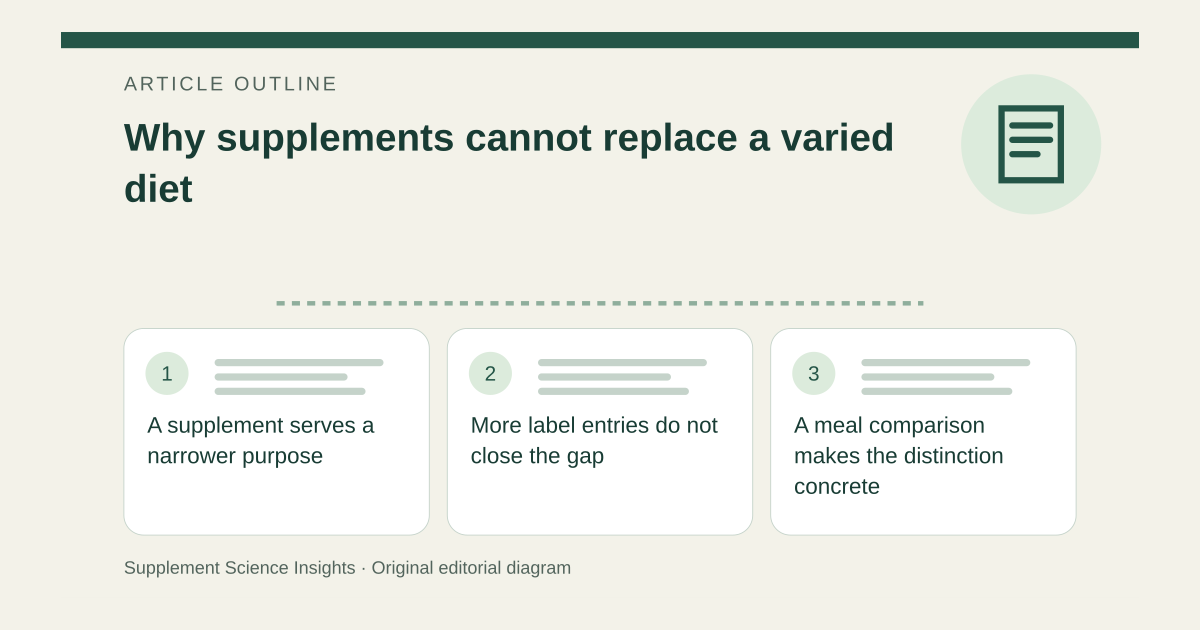
A supplement serves a narrower purpose
A multivitamin can increase intake of the nutrients it contains. That does not make it nutritionally equivalent to a varied diet. ODS explicitly distinguishes adding selected nutrients from replacing foods, which provide fiber and other useful components as part of an eating pattern. [1]
More label entries do not close the gap
A formula can contain many vitamins and still be unsuitable as the sole source of nourishment. FDA’s dietary-supplement category is not represented as a conventional food or the sole item of a meal or diet. Products designed for medically supervised nutritional support raise a different question from a daily supplement bottle. [2]
A meal comparison makes the distinction concrete
Imagine replacing lunch with a multivitamin and water. The tablet may provide its listed nutrients, but that does not reproduce the meal. A more useful role might be addressing a specific inadequacy while preserving food intake. If illness or swallowing problems prevent eating, obtain nutritional assessment rather than trying to solve the problem by increasing vitamin doses. [1]
| Example | Interpretation |
|---|---|
| Multivitamin | Selected nutrient addition |
| Varied meal | Broader food contribution |
| Inability to eat | Needs nutritional assessment |
Sources for this article
- Multivitamin/mineral Supplements
Source consulted: 2026-09-20. This is a reference resource, not a claim that we conducted the studies or tested a product. - Questions and Answers on Dietary Supplements | FDA
Source consulted: 2026-09-20. This is a reference resource, not a claim that we conducted the studies or tested a product.