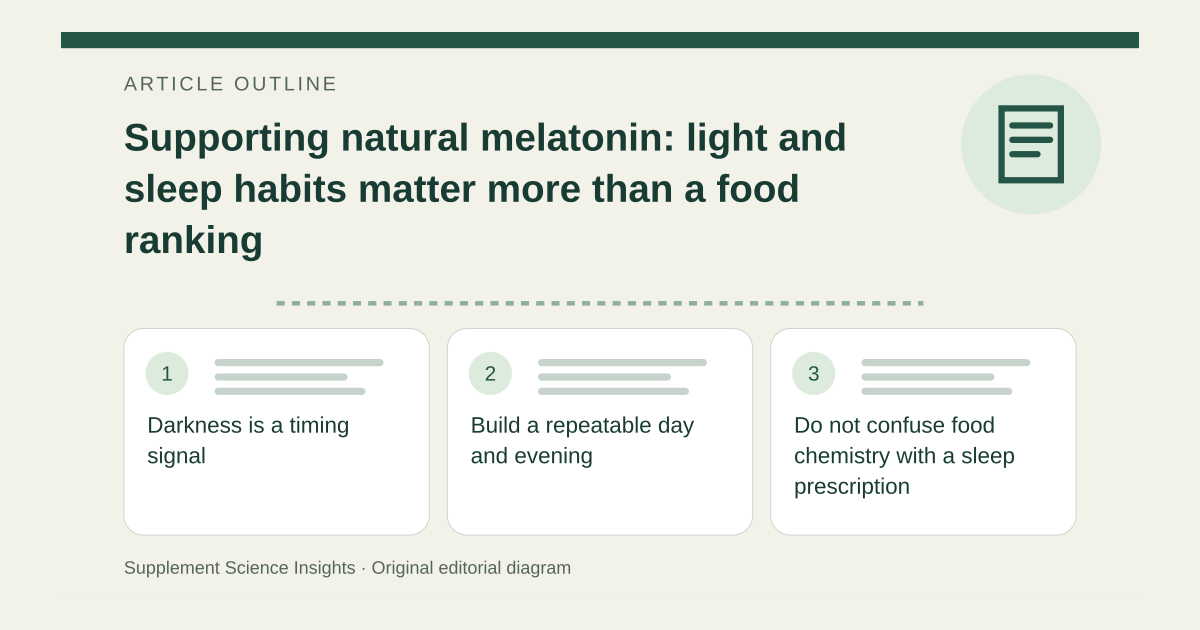
Darkness is a timing signal
NHLBI explains that evening melatonin release helps prepare the body for sleep and that bright artificial light late in the evening can disrupt that process. The objective is a useful daily rhythm, not continuously high melatonin throughout the day. [1]
Build a repeatable day and evening
Keep bedtime and wake time reasonably consistent, spend time outdoors when possible, and reserve the hour before bed for quieter activity with less bright light. NHLBI also recommends a quiet, cool, dark bedroom. Shift workers may need a different plan matched to their work and daytime sleep. [2]
Do not confuse food chemistry with a sleep prescription
The body synthesizes melatonin through a pathway that begins with tryptophan and includes serotonin. That biochemical relationship does not establish that one food or a precursor supplement will correct your sleep problem. A claimed food melatonin amount also does not specify the timing effect in a person. [3][4]
Consider what interferes with sleep
NHLBI advises avoiding alcohol before bed and considering caffeine, whose effects can persist for hours. Persistent difficulty sleeping needs assessment instead of assuming a nutrient or hormone deficit. Different sleep disorders require different approaches. [2][4]
Change the routine before chasing a number
Imagine late bright-screen use, irregular wake times and afternoon caffeine all change from day to day. A consistent routine makes those influences easier to assess. It does not prove a deficiency has been cured or that supplements are needed. [2][1]
| Feature | Useful observation |
|---|---|
| Evening light | Brightness and timing |
| Sleep schedule | Consistency and opportunity |
| Food or supplement claim | Does not diagnose deficiency |
Sources for this article
- Sleep Deprivation and Deficiency - What Makes You Sleep? | NHLBI, NIH
Source consulted: 2026-09-21. This is a reference resource, not a claim that we conducted the studies or tested a product. - Sleep Deprivation and Deficiency - Healthy Sleep Habits | NHLBI, NIH
Source consulted: 2026-09-21. This is a reference resource, not a claim that we conducted the studies or tested a product. - Physiology of the Pineal Gland and Melatonin - Endotext - NCBI Bookshelf
Source consulted: 2026-09-21. This is a reference resource, not a claim that we conducted the studies or tested a product. - Melatonin: What You Need To Know | NCCIH
Source consulted: 2026-09-21. This is a reference resource, not a claim that we conducted the studies or tested a product.