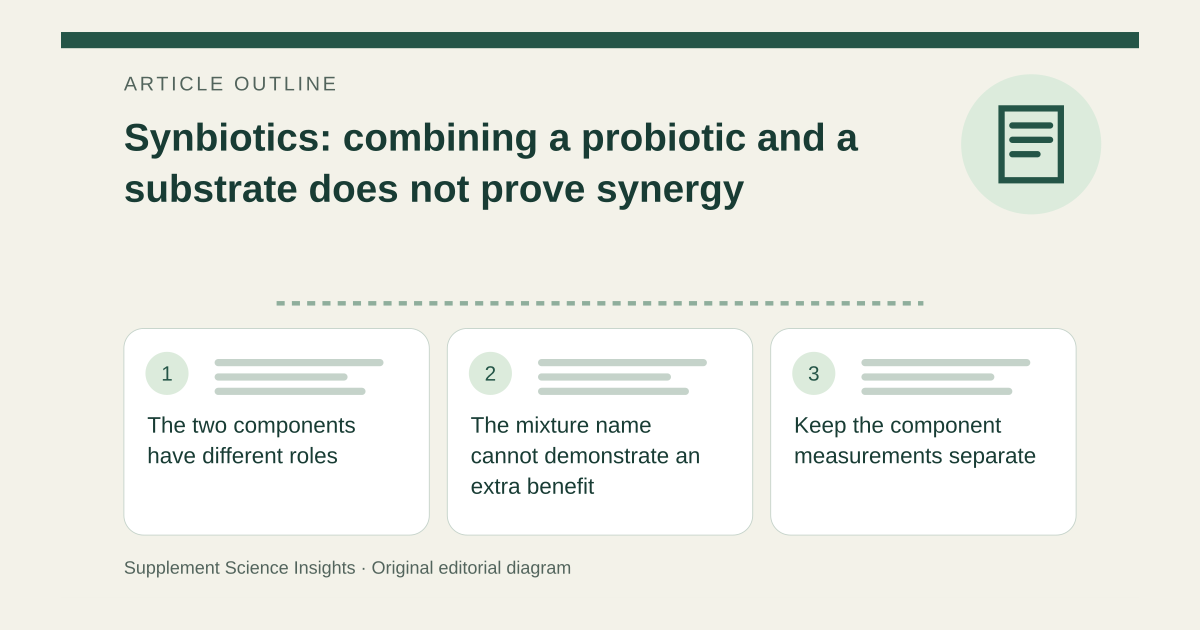
The two components have different roles
NCCIH distinguishes probiotics, which are live microorganisms, from prebiotics, which are nondigestible food components that selectively support desirable microbial growth or activity. Its introductory description calls products combining them synbiotics. [1][2]
The prebiotic component is not another organism to add to a CFU count. Likewise, a probiotic’s organism count is not a gram amount of fiber. A complete description needs the identity and amount of each component. [1][2]
The mixture name cannot demonstrate an extra benefit
Different probiotic strains can have different effects, and evidence for one use does not establish all other uses. Adding a prebiotic ingredient does not by itself prove that the mixture performs better than either component alone. [1][2]
For a synergy claim, an appropriate comparison would need to distinguish the combined preparation from its components. A trial against placebo may evaluate that formulation’s effect without isolating which ingredient contributed or proving a more-than-additive effect. [1][2]
Keep the component measurements separate
Imagine a label lists a named bacterial strain in CFU and a prebiotic ingredient in grams. The two entries can be documented, but they cannot be added into one dose number. If a study tested another strain or substrate, the shared synbiotic label does not establish equivalence.
| Detail | Interpretation |
|---|---|
| Strain and CFU | Live-microbe component |
| Substrate and grams | Prebiotic component |
| Synergy | Needs an appropriate comparison |
Sources for this article
- NCCIH: Probiotics—Usefulness and Safety
Source consulted: 2026-09-17. This is a reference resource, not a claim that we conducted the studies or tested a product. - NIH ODS: Probiotics
Source consulted: 2026-09-17. This is a reference resource, not a claim that we conducted the studies or tested a product.