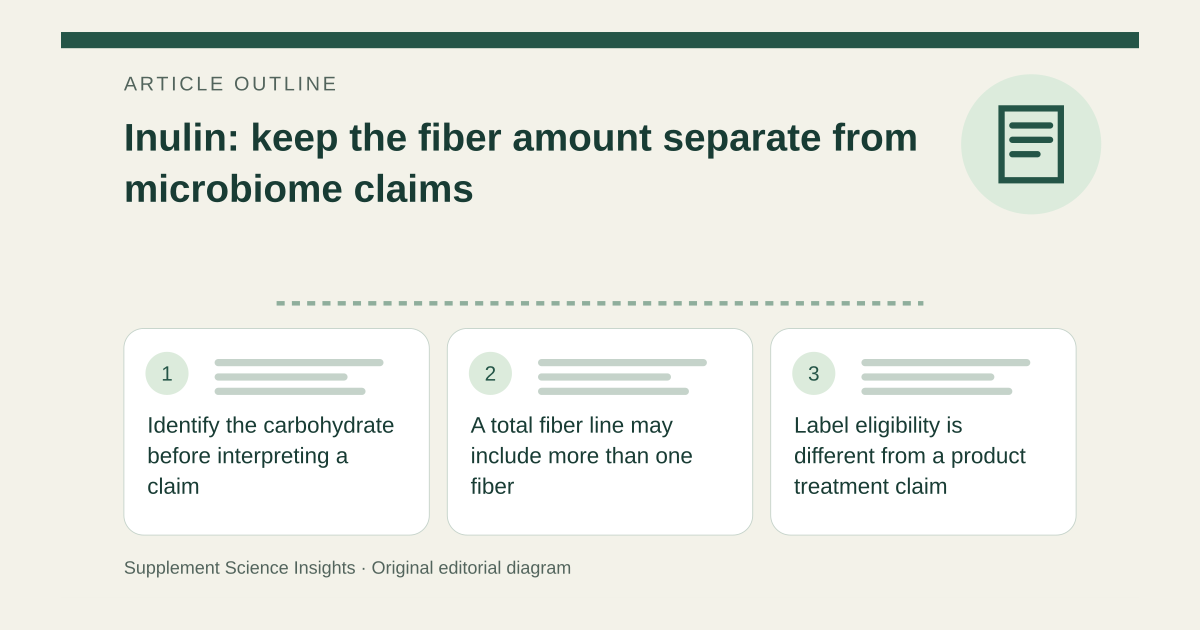
Identify the carbohydrate before interpreting a claim
Inulin and inulin-type fructans are non-digestible carbohydrates discussed in FDA’s dietary-fiber guidance. They are not live microorganisms. A product can contain both a fiber and a probiotic, but those entries describe different ingredients. [1]
Record the named fiber, stated amount and other ingredients separately. A product title using the word prebiotic does not supply a measured quantity, a complete formulation or evidence that every claimed digestive outcome was tested. [1]
A total fiber line may include more than one fiber
Imagine a fictional serving declares 4 g total dietary fiber and separately identifies 2 g of inulin. The inulin entry does not automatically account for the entire fiber total. The remaining contribution requires the complete formulation and supporting label information.
If another product names inulin but gives no separate amount, write “individual amount not disclosed.” Do not assign the full dietary-fiber number to it. These invented entries are not recommended quantities or a verified comparison of retail products.
| Entry | Interpretation |
|---|---|
| Total dietary fiber: 4 g | Total fiber declared for the serving |
| Inulin separately declared: 2 g | Identified inulin contribution |
| Remaining fiber contribution | Requires full formulation information |
| Inulin named without a quantity | Individual amount remains undisclosed |
Label eligibility is different from a product treatment claim
FDA’s current question-and-answer page includes inulin-type fructans among additional fibers covered by its stated enforcement-discretion approach while rulemaking is pending. That labeling context does not establish that an individual product treats a gastrointestinal condition. [1]
Keep the regulatory question separate from the health question: whether an ingredient may be included in a fiber declaration is not the same as whether a preparation improves a specified symptom in a particular population. [1]
A microbiome change and symptom relief are different endpoints
A 2017 trial by Azpiroz and colleagues studied 36 selected adults over four weeks using chicory-derived inulin or placebo. It assessed a gas challenge, symptoms and fecal bacteria. The reported between-group gas-retention difference was not statistically significant, despite a decrease from baseline in the inulin group. [2]
Beneo and Spanish public funding supported the work; two authors were Beneo employees. This small, selected study illustrates why a within-group change must not be presented as proof of benefit over placebo or generalized to all inulin products. [2]
Keep digestive symptoms and the full product visible
When discussing tolerance with a clinician, record the exact product, other fibers or sweeteners, actual use and timing of symptoms. A small study in selected participants cannot determine how every reader will respond. [2][3][4]
Do not assume that adding more fiber is the appropriate response to persistent or worsening digestive symptoms. Seek clinical advice rather than using this worksheet to diagnose their cause. This page supplies no symptom-treatment or dose-escalation schedule. [2][3][4]
The source scope remains narrow
The label example distinguishes an ingredient quantity from a total fiber declaration. The trial example distinguishes a within-group observation from a between-group comparison. Neither establishes a universal prebiotic benefit.
The FDA resource and original trial were inspected for those limited purposes. A current systematic review, full correction-history check and qualified individual safety assessment have not been completed. Independent scientific and editorial acceptance remains pending.
Sources for this article
- FDA — Questions and Answers on Dietary Fiber
Source consulted: 2026-09-17. This is a reference resource, not a claim that we conducted the studies or tested a product. - Azpiroz et al. (2017) — Effect of Chicory-derived Inulin on Abdominal Sensations and Bowel Motor Function
Source consulted: 2026-09-17. This is a reference resource, not a claim that we conducted the studies or tested a product. - NIH ODS — Dietary Supplements: What You Need to Know
Source consulted: 2026-09-17. This is a reference resource, not a claim that we conducted the studies or tested a product. - MedlinePlus — Abdominal Pain
Source consulted: 2026-09-17. This is a reference resource, not a claim that we conducted the studies or tested a product.