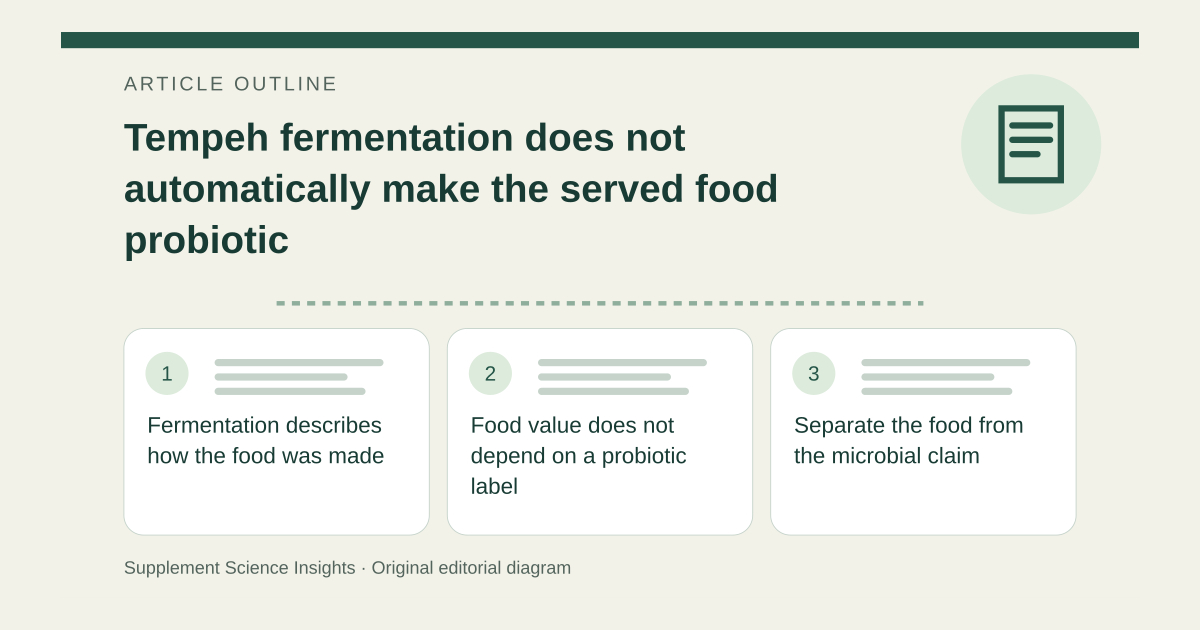
Fermentation describes how the food was made
The ISAPP consensus includes tempeh among fermented foods that can contain live microorganisms. It also distinguishes fermentation from proof that a final food meets the probiotic definition. [1]
The processing history after fermentation matters. A statement about an earlier production stage does not, by itself, quantify viable organisms at consumption. [1]
Food value does not depend on a probiotic label
The consensus states that probiotic labeling requires defined microbial content and evidence that the live components provide a benefit. Being fermented is not enough. [1]
This distinction does not imply that tempeh lacks nutritional value. It prevents benefits of the food’s nutrients or overall dietary role from being attributed automatically to a specific live-microbe intervention. [1]
Separate the food from the microbial claim
Imagine a package identifies tempeh but provides no verified strain or clinical outcome. The food identity alone does not establish equivalence to a studied probiotic preparation.
| Detail | Interpretation |
|---|---|
| Tempeh | Fermented food |
| Live content | Depends on the finished serving |
| Probiotic claim | Needs defined benefit evidence |
Sources for this article
- The International Scientific Association for Probiotics and Prebiotics (ISAPP) consensus statement on fermented foods | Nature Reviews Gastroenterology & Hepatology
Source consulted: 2026-09-18. This is a reference resource, not a claim that we conducted the studies or tested a product.