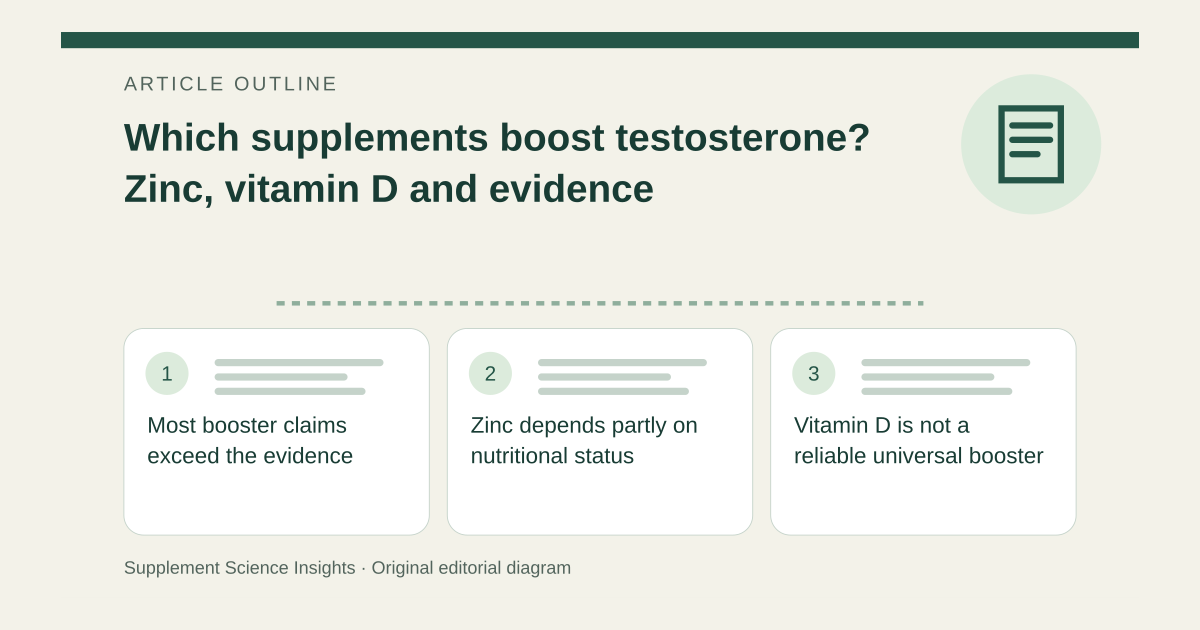
Most booster claims exceed the evidence
A systematic review of 52 studies covering 27 proposed boosters found that most failed to increase total testosterone. It identified limited signals for some ingredients in particular populations. Such signals do not establish a general recommendation, long-term safety or improvement in symptoms or fertility. [1]
Zinc depends partly on nutritional status
A zinc-focused review included limited human studies alongside many animal experiments and described status-dependent findings. Correcting insufficient zinc is a different proposition from raising intake in an adequately nourished person. Excess can produce stomach symptoms and copper-related harm. [2][3]
Vitamin D is not a reliable universal booster
The broad booster review included vitamin D studies but did not establish it as a dependable general testosterone intervention. Vitamin D can still be needed for ordinary nutritional reasons. Increasing it beyond an appropriate intake to chase a hormone level introduces toxicity risk without an established benefit. [1][4]
Confirm the problem before choosing treatment
The Endocrine Society describes diagnosis using relevant symptoms plus consistently low, accurately measured testosterone, with repeated early-morning fasting tests. Fatigue or reduced libido alone cannot identify the cause. Assessment can reveal issues that a supplement stack would not address. [5]
Separate nutrient correction from hormone treatment
Imagine someone has low vitamin D and a single afternoon testosterone result. Correcting the nutrient shortfall does not validate a hypogonadism diagnosis. Repeat appropriate testing and clinical review before assuming a supplement will resolve both findings. [5][4]
| Question | Why it matters |
|---|---|
| Confirmed nutritional shortfall? | A reason for targeted correction |
| Repeated appropriate hormone tests? | Avoid misclassification |
| Relevant human outcome evidence? | Mechanism is insufficient |
| Full dose and ingredients? | Benefit and safety depend on exposure |
Sources for this article
- Do "testosterone boosters" really increase serum total testosterone? A systematic review.
Source consulted: 2026-09-21. This is a reference resource, not a claim that we conducted the studies or tested a product. - Correlation between serum zinc and testosterone: A systematic review.
Source consulted: 2026-09-21. This is a reference resource, not a claim that we conducted the studies or tested a product. - Zinc - Health Professional Fact Sheet
Source consulted: 2026-09-21. This is a reference resource, not a claim that we conducted the studies or tested a product. - Vitamin D - Health Professional Fact Sheet
Source consulted: 2026-09-21. This is a reference resource, not a claim that we conducted the studies or tested a product. - Statement on Testosterone Replacement Therapy | Endocrine Society
Source consulted: 2026-09-21. This is a reference resource, not a claim that we conducted the studies or tested a product.