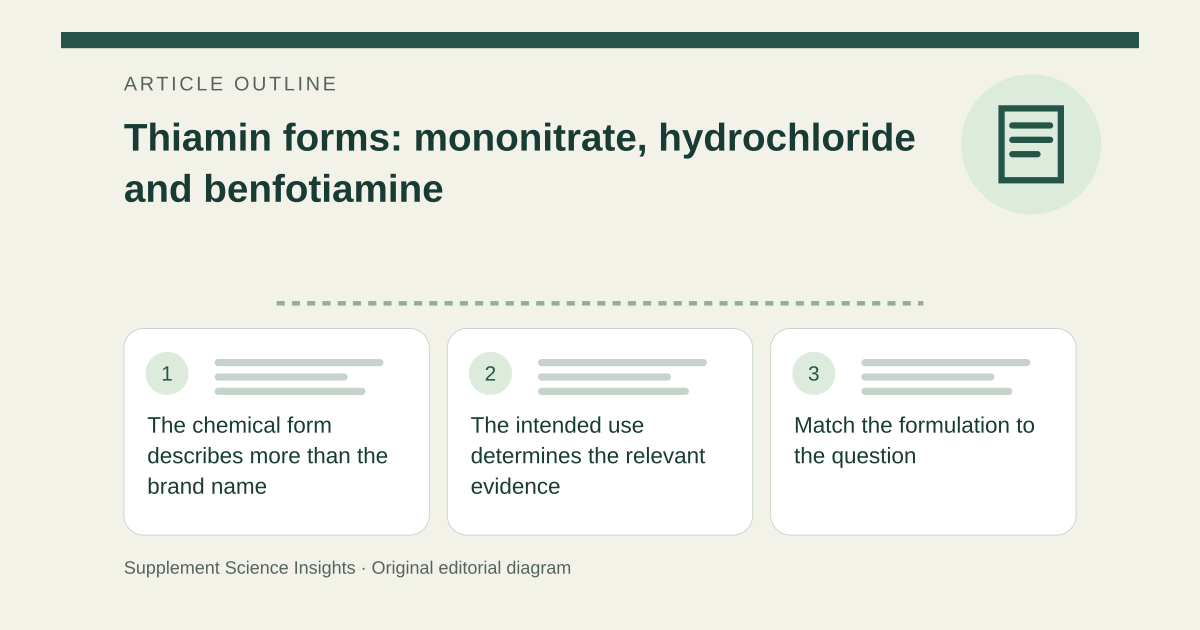
The chemical form describes more than the brand name
NIH ODS identifies thiamin hydrochloride and thiamin mononitrate as commonly used stable forms. It distinguishes benfotiamine as a derivative that is not water soluble. [1]
Those differences help identify the ingredient. They do not establish a universal ranking for every nutritional or clinical purpose. [1]
The intended use determines the relevant evidence
Routine nutritional intake, treatment of a diagnosed deficiency and a study of a particular disease are different contexts. Compare evidence for the actual preparation and purpose rather than choosing solely by an absorption claim. [1]
A more elaborate ingredient name does not itself establish superior symptom relief. A prescribed treatment should not be substituted with a retail derivative without checking the clinical plan. [1]
Match the formulation to the question
Imagine a trial studies benfotiamine for a specific condition. That does not demonstrate that every person seeking routine B1 intake should prefer it to mononitrate or hydrochloride.
| Detail | Interpretation |
|---|---|
| Hydrochloride/mononitrate | Common water-soluble forms |
| Benfotiamine | Different derivative |
| Best choice | Depends on purpose and evidence |
Sources for this article
- Thiamin - Health Professional Fact Sheet
Source consulted: 2026-09-17. This is a reference resource, not a claim that we conducted the studies or tested a product.